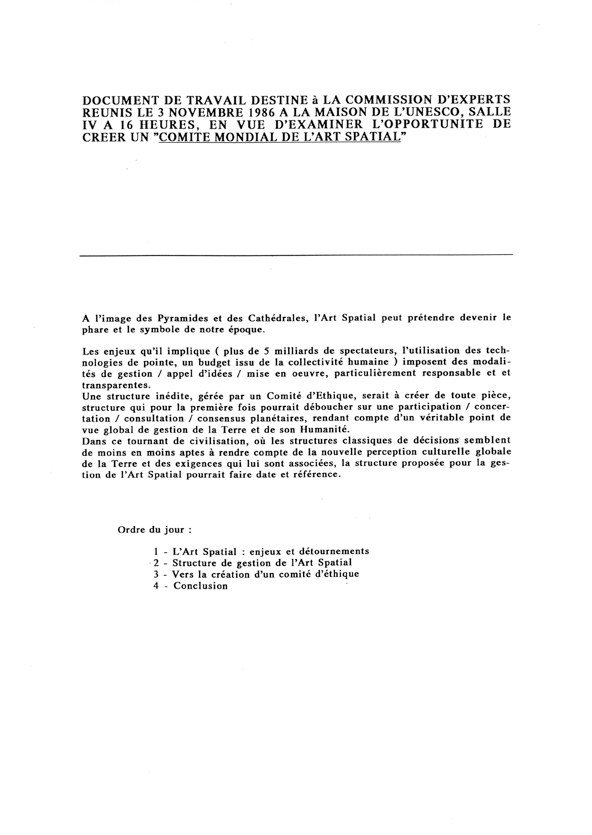
World Space Art Committee: Working Paper
Typewritten working paper (7 pages) submitted to the committee of experts convened on 3 November 1986 at the Maison de l'UNESCO, Paris.
p. 1
WORKING PAPER FOR THE COMMISSION OF EXPERTS MEETING ON 3 NOVEMBER 1986 AT THE MAISON DE L'UNESCO, ROOM IV, AT 4 P.M., TO CONSIDER THE ADVISABILITY OF CREATING A “WORLD SPACE ART COMMITTEE”
Like the Pyramids and the Cathedrals, Space Art can aspire to become the beacon and the symbol of our age.
The stakes it involves (more than 5 billion spectators, the use of cutting-edge technologies, a budget drawn from the human community) call for particularly responsible and transparent arrangements for management / call for ideas / implementation.
An unprecedented structure, managed by an Ethics Committee, would have to be created from scratch — a structure that for the first time could lead to planetary participation / dialogue / consultation / consensus, reflecting a genuinely global perspective on the management of the Earth and its Humanity.
At this turning point of civilisation, when classical decision-making structures seem less and less able to account for the new global cultural perception of the Earth and the demands associated with it, the structure proposed for the management of Space Art could become a landmark and a point of reference.
Agenda:
- 1 - Space Art: stakes and misappropriations
- 2 - Management structure for Space Art
- 3 - Towards the creation of an ethics committee
- 4 - Conclusion
p. 2
I - THE CONQUEST OF SPACE: SYMBOL OF CIVILISATION AND CULTURAL CATALYST
A beacon element, representative and significant of our know-how in this second half of the 20th century, the conquest of space has, since 1959 (the first Sputnik), induced a cultural component specific to the era.
Besides the scientific gains inherent in this conquest, 25 years of development — including man's first step on the Moon — have resulted in:
- an unprecedented perception of the very notion of Space:
- in its conceptual and philosophical approach,
- in its scientific practice.
- an unprecedented perception, too, of the Earth revealed from outside, objectively.
Through, in particular, images that are especially compelling and widely disseminated by every modern means of communication, a characteristic cultural respiration has taken hold. A new imaginary, which we all now carry within us, and archetypes of its own have become established. In particular, it is henceforth no longer possible to apprehend the planet from angles involving only the “local”; we must now integrate into it the dimension of the “global”.
The conquest of space has thus enabled us to RE-DISCOVER the planet, bringing about shifts in point of view, and inevitable questions are to be expected concerning our frames of reference and the traditions that direct and govern us.
Such a state of affairs, as fundamental as Galileo's discovery in its day, confronts us with a new kind of demand. Here is an opportunity to be seized, for it is rare in the history of a civilisation to encounter such a widening of perception, whose consequences may prove decisive for the future of Humanity with regard – in particular – to its current military management, to its policy for managing the planet's resources, and to its economic practices.
One might therefore wish, through an exemplary act of symbolic value, to give expression to and affirm this global awareness and the new sense of responsibility inherent in it, by applying – for the 1st time, in the service of this act – a principle of planetary consensus and global consultation, capable of setting a landmark and a precedent.
The meeting of the field of perception arising from the conquest of space and the field of artistic invention can provide this unique opportunity, by way of Space Art.
II - SPACE ART
Niels BOHR: “Art instantly expresses a situation in its totality”
For some ten years now, institutions and individuals – engineers, researchers, artists – sensitive to this new cultural emanation have been devising projects:
p. 3
Artificial stars, fixed or mobile, a Ring of artificial stars, artificial moons, luminous artefacts on the “dark side of the moon”... Reports have dealt with the artistic potential of space, exhibitions have been devoted to it, television programmes too, and conferences have been made aware of it (European Conference of Philosophy, Franco-Japanese Cultural Summit...).
Indeed, technological know-how now enables Man to inscribe his presence against the backdrop of the sky or the firmament by a “sign” of this kind.
Reminder: Among the masterly works belonging to the heritage of humankind, many were brought into being because the most sophisticated technical processes of their time were placed at the disposal of the artistic imagination. These works, in particular, have endured and asserted themselves as true tangible memories of our past. So it is with the Pyramids, the Great Wall of China, the Cathedrals... And today these works do seem to contain and transmit to us the idea of their own desire or their own enigma, and to call upon the mind's eye.
III - SPACE ART AND ITS IMPLEMENTATION: THE VERY EXAMPLE OF A CHANGE OF SCALE IN ARTISTIC EXPRESSION AND OF A NEW, ASSOCIATED FORM OF RESPONSIBILITY
WHAT IS AT STAKE IN SPACE ART
Through its field of application and the means it brings into play, Space Art implies a radical change of scale. Its ambition is considerable for, beyond the spectacle it offers, awakening and setting in resonance the most ancestral myths anchored in our collective unconscious, it involves:
- A grandstand that is none other than the whole Earth, on whose tiers sit 5 billion human beings who are necessarily concerned,
- Technological know-how resting on the work and commitment of several generations of engineers and researchers,
- financial resources drawn from the community,
- a will to carry it out.
It offers:
- An aesthetic on a planetary scale which, properly managed, could be a true sign of civilisation, capable of expressing in a sensory way, and thereby revealing, what was set out on the first page of this note: a generalised awareness of the Earth/humanity whole.
CONSEQUENCE OF THESE STAKES: THE WARNINGS
Given the stakes set out above, precautions are essential so as not to squander the rare opportunity that Space Art holds. In particular:
- it would be unseemly and dismaying for Space Art to be used as a unilateral means of cultural propaganda or of ideological assertion, imposed by one Nation or another – those that have the technical means – in the face of the rest of the world.
p. 4
- it would be even more deplorable if the first implementation of Space Art merely demonstrated the efficiency of a few multinationals, financial groups or private or ad hoc interest groups, through an artificial and disproportionate promotion of themselves.
- it would also be astounding if a simplistic and misleading project of this kind were launched into space on the pretext of quick and expedient feasibility.
Note: it goes without saying, as with the anonymous cathedrals, that no name of any institution or artist could be attached to a work of Space Art, precisely insofar as these ideas emanate directly from the establishment of the new cultural perception brought about by the conquest of space.
IV - TOWARDS THE CREATION OF A COMMITTEE FOR AN ETHICS OF THE USE OF SPACE FOR ARTISTIC PURPOSES
PURPOSE AND MISSION OF THIS COMMITTEE
- To make the 1st work of Space Art a COLLECTIVE CELEBRATION on a planetary scale.
- To ensure, in this still virgin field, the implementation of a mature and fruitful concept, arising from a worldwide consultation and a planetary consensus.
- To propose a structure – international and multicultural – guaranteeing the responsible management of Space Art, a structure based at the headquarters of the Académie Européenne des Sciences, des Arts et des Lettres in Paris.
INTENTIONS AND PROPOSALS
1 - Through a concerted worldwide media campaign involving television, radio and the written press (in all its forms, including an international review of the UNESCO type), and also calling upon local university and school structures:
- To make known the stakes and the intentions of Space Art,
- To create, on a planetary level, the optimal conditions for a genuine challenge, with a call for ideas.
2 - Gathering together of all the ideas and concepts pertaining to Space Art:
- Survey of the current pre-existing projects, which often overlap and are sometimes unaware of one another: e.g.: there are many projects for reflector-type satellites in low orbit: USA, USSR, EUROPE.
- Receipt of the new projects arising from the consultation under point 1.
3 - Examination of all the projects by a small Technical Council:
- Synthesis: classification by tendency,
- Possible merging of complementary projects.
4 - Identification and definition of the Main Projects resulting from the preceding synthesis.
- Drawing up of the corresponding specifications.
p. 5
5 - Distribution of the specifications to the various international bodies concerned (space agencies, institutions, industries, research laboratories).
- Study of feasibility, cost, timescales, date of implementation.
N.B.: various contacts already established suggest that, in the context of this form of implementation of Space Art, these studies could be provided free of charge.
6 - Actual simulation in a PLANETARIUM of the main projects.
7 - Parallel studies and surveys of the practical implications of the possible placing of these projects in space for the various fields of human knowledge:
e.g.:
- Astronomy, Astrophysics: consultation of the representative associations,
- Ornithology: consequences of an artificial luminous artefact on the migration of birds,
- Human sciences: impact and possible antinomy among primitive populations – remedies and prevention.
8 - New media campaign on a worldwide scale: planetary referendum on the main projects still in competition:
- Designation by plebiscite of the project thus chosen.
9 - Consultation of the world's main space agencies:
- Choice of the date of implementation.
10 - Placing in space of the project chosen by plebiscite:
- The first global Celebration, on a planetary scale.
Reminder: such a project could not bear any “signature”, whether of an individual, of an industrial firm, of an institution or of a Nation; its very MEANING lies in the idea of a work “from Humankind to Humankind”.
THE VARIOUS FUNDING HYPOTHESES
If we agree to play the card of a particularly innovative and responsible management of the Earth and its Humanity through Space Art, one funding proposal suggests itself – a proposal which, by a first reflex born of tradition, may seem a tall order to those in charge of institutions, but which, given a certain sense of the “grave”, could not fail to trigger genuine popular support, thereby reinforcing the media campaigns mentioned above.
- this first proposal would have the various peoples and nations asked to meet the cost of the Space Art project chosen by plebiscite by means of a levy, identical in percentage, taken from the military budgets of the various countries.
p. 6
Reminder: every minute that passes costs the planet $1,300,000 in the name of the world military effort. The development of this research and of these commitments is responsible, in particular, for the uncertainty as to the lifespan of our civilisation. In the face of this threat, it is currently being considered to place in orbit a satellite that would contain the most important moments of humanity, its most outstanding works and the elements of its acquired knowledge, so that, whatever happens, the “memory of humanity” would be saved!
Initial estimates of the costs of a Space Art project indicate that they would correspond to only a few hours a year of the world's military spending, hours spread over several years.
If, however, the maturity of minds and consciences should nevertheless prove incredulous in the face of the preceding proposal, other funding arrangements could be substituted for it:
- levies, identical in percentage for all countries, made in proportion to the gross national product of each of them.
- concerted action involving public and private international institutions: ministries of culture, public or private foundations.
Note: out of concern for the effective participation of the various peoples and ethnic groups of the Earth, aboriginal populations, for example, would be invited to make a commitment in the form of a symbolic gift, giving concrete expression to their involvement through this gesture.
V - SPACE ART, A UNIQUE OPPORTUNITY TO BE SEIZED, CAPABLE OF SETTING A LANDMARK AND A PRECEDENT
At a moment in civilisation when the Earth, more than ever, lacks ambition and purpose, and lacks even more a point of convergence for action that calls upon collective hope, and upon that “something else” not yet named... enthusiasm, perhaps, Space Art, managed as has just been proposed, offers a unique opportunity capable
- of satisfying all parties and all points of view, whether cultural or political,
- of heralding an unprecedented dynamic of behaviour with a view to a collective management requiring a global awareness on the part of Humankind, and,
- of bringing human beings together through the exercise of a practice that is universal to them: ART,
- of restoring to this essential component – Art – an everyday mental dimension, a physical dimension on the scale of their most up-to-date know-how and an unparalleled Historical dimension,
- of offering, through its accomplishment, a new meaning to technologies that are still seeking purposes not yet found,
- of exalting the idea of Man and of his capacities,
- of foreshadowing some near ideal not yet formulated,
- of offering a cause for planetary enthusiasm and the occasion for a worldwide celebration.
p. 7
Such a conjunction is rare and no substitute action of any kind whatsoever, as far as one may look, could be as revealing and symbolic: here is a unique opportunity not to be wasted.
A political decision at the level of the various governments and of the Directorates of the world's various Space Agencies could be taken rapidly so that an agreement in principle may be signed very soon and so that no initiative serving merely local interests (a commemoration, a centenary, an act of cultural or commercial propaganda or of advertising...) may with impunity deflower such a potential.
Finally, one may hope and believe that such an implementation of the first concept of Space Art, combined with a rigorous ethics, according to the protocol described in this note, could set a landmark and a precedent at this moment in civilisation when conventional structures of decision-making seem less and less able to account for the new cultural situation linked to a global perception of the Earth. Here again, Space Art would be exemplary, perhaps even premonitory.
Jean-Marc PHILIPPE
Transcribed from the original edition (Jean-Marc Philippe archives). © Jean-Marc Philippe / rights holders.