The Variations
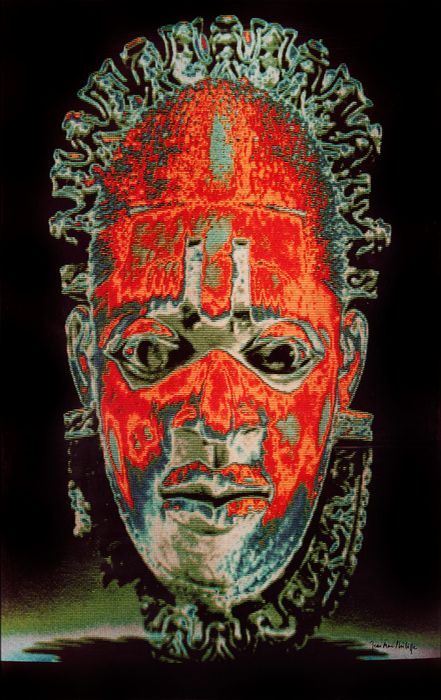
In the 1970s, NASA developed a tool called a colorizer to assign colours systematically to images captured in space, in order to make them easier to interpret. This tool reached Europe a few years later. Jean-Marc Philippe then diverted this new technology to incorporate it into his artistic practice.
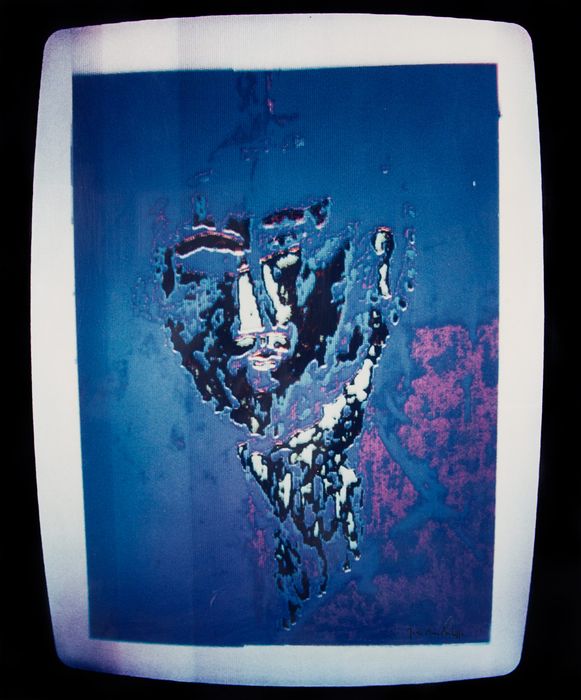
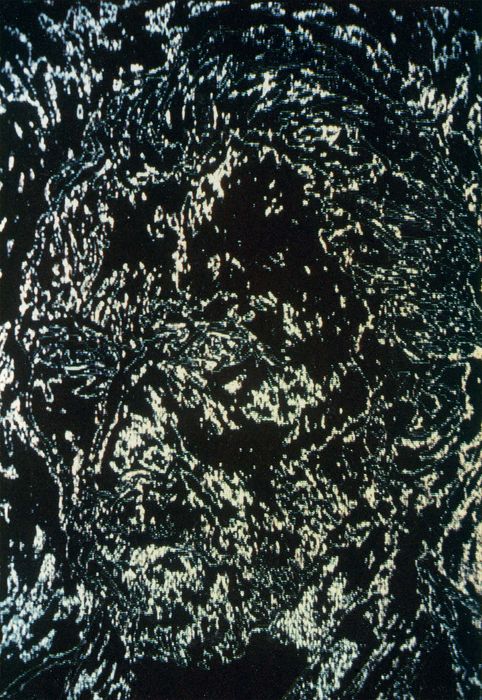
One of the processes he devised consisted in projecting a black-and-white photograph onto a cathode-ray screen in order to break the image down into its constituent shades of grey. Using the colorizer he assigned colours to them; then, by modifying the electronic circuit, he was able to manipulate intensity, shades and contrasts, which allowed him to “distort” the image in question endlessly.
Produced with an analogue computer (before the digital era), these images were “instantaneous” and could only be reproduced by photographing the screen itself with a film camera.
In the mid-1980s, Jean-Marc Philippe created three series of works from the photographic reproduction of a painting by Amedeo Modigliani, a self-portrait by Vincent Van Gogh and a 16th-century Beninese mask. He called these series of images “the Variations”.
Writings
By Jean-Marc Philippe
- Artistic Invention and its Metamorphosis — in Modernes et après : « Les Immatériaux », Paris, Autrement, 1985, pp. 173-182.
On Jean-Marc Philippe
- Portrait of the Artist on Video — Gilles Tordjman, “Portrait de l'artiste en vidéo”, Revue d'esthétique, no. 10 (“Vidéo-Vidéo”), Toulouse, Privat, 1986, pp. 155-158.
References and links
Books, catalogues and journals
- Gilles Tordjman, “Portrait de l'artiste en vidéo”, Revue d'esthétique, no. 10 (“Vidéo-Vidéo”), Privat, 1986, pp. 155-158.
- Françoise Armengaud, Titres, Paris, Klincksieck, 1988, chapter “Jean-Marc Philippe”, pp. 213-222.