Art and Shape-Memory Alloys
Leonardo, vol. 22, no. 1, Pergamon Press / ISAST, January 1989, pp. 117-120; translated and revised by Philippe Poncet, based on a presentation given at the colloquium “The Scientific Dimension of Cultural Development” (UNESCO and the European Academy of Sciences, Arts and Letters, Rome, 29 September – 2 October 1987). © 1989 ISAST.
See: Shape-memory alloys, The Circle of Life, Hermaphrodite, The Totem of the Future
p. 117
Abstract. The specific properties of shape-memory alloys, when applied to art, are capable of reinventing sculpture. The ability of these shape-memory alloys to ‘learn’ and ‘memorize’ different shapes at different temperatures — shapes that they will remember rigorously when they again meet these same temperatures — adds an unedited dimension and new degree of freedom to sculpture. The efforts that have been made to realize the first monumental sculpture out of solid nickel-titanium have permitted the two partners, industry and art, to mutually enrich themselves by extending the limits of technological knowledge and by opening a new arena for the artist’s imagination.
Art and Technology: Art and Shape-Memory Alloys
The exponential explosion of scientific knowledge and technological savoir-faire, characteristic of our society today, cannot be indifferent to human sensitivities and artistic creation. If science can be a mental source for models or inspirations, then technology can provide the new tools for artistic creation. In the latter case, two tendencies have appeared in the last few years: artists who take existing technologies and integrate them into their artworks, or artists who demand more of these technologies and adapt them to their creative needs.
This second tendency characterizes the relationship between art and shape-memory alloys in my sculpture. It is a relationship that augurs an unedited synergy between art, research and industry, a relationship that innovates the logic of economics by including art as a valuable partner.
Shape-Memory Alloys Presentation
The Bronze Age, the Iron Age … the Shape Memory Age. The reversible martensitic transformation that leads to the shape-memory effect had been noted as early as 1932 for gold-cadmium [1] and 1938 for copper-zinc alloys [2]. Beginning in the 1950s, Thomas A. Read and his coworkers in the
p. 118
mechanical engineering department at the University of Illinois investigated these materials [3], but it was not until 1962 that W. J. Buehler and his coworkers at the Naval Ordnance Laboratory discovered that nickel-titanium (named NiTiNOL by Buehler) showed this shape-memory effect [4]. Since then, a large number of alloy systems have been investigated (copper-based alloys and the nickel-titanium family are still the most commercially attractive systems), and both the interest in shape-memory alloys and the level of product development using these materials have increased dramatically and are still growing.
The shape-memory effect describes the ability of certain metals to ‘remember’ a previous shape. These metals can be deformed (bent, twisted, stretched, etc.) below a specific temperature, yet they will return to their previous shape when heated slightly above this temperature. Although the metals are perfectly stable below this temperature, heating causes them to recover their original shape instantaneously. Some alloys can even remember both shapes, with heating causing a recovery to the undeformed shape and cooling causing a return to the deformed configuration — the so-called two-way memory effect.
Alloys exhibiting these effects include nickel-titanium, copper-zinc-aluminum, copper-aluminum-nickel, gold-cadmium and indium-thallium. These materials allow shape changes to occur at temperatures between −196 °C and +150 °C but current research is aimed at developing new alloys to extend this range and reduce costs.
Early applications (1969) for shape-memory alloys have included hollow cylinders that could be heated and shrunk onto tubes and pipes to form highly reliable joints (Raychem’s Cryofit® pipe coupling) — a technique that is used today in nuclear power plants, critical aircraft hydraulic systems, etc. For years, the extreme difficulty involved in producing these alloys in a consistent way has hampered their development, but now the dream of shape memory is becoming reality.
What does the future hold? It is as if we are climbing a long, steep staircase on a foggy day: we know we are climbing, but there is no leveling in sight, and the end is so far away that we are unable to envision it. I believe that the marriage of shape-memory alloys and the art world will bring about the rejuvenation of metallurgy.
A Reinvention of Sculpture
Seven years ago, I discovered shape-memory alloys through technical papers in journals and while attending a conference in Paris where the topic was “Memory …” Since then I have been working with shape-memory alloys. The causes of my dedication are several:
- The emotion that arises when observing the phenomenon of shape-memory behavior: a shock based on initiation; enigma, strangeness, beauty of transformations; a new relationship to matter; an uprising of consciousness without equivalence; cultural images that come to mind: “Objets inanimés, avez-vous donc une âme ?” (Lamartine)
- The omnipresence of the phenomenon in the world around us: now that it has been identified, the phenomenon seems to be present in many situations. Besides its presence in metallic alloys, it exists in plastics, ceramics, hair, bacteria, non-wrinkling fabrics and spermatozoid flagella. It would seem that this phenomenon is not foreign to shapes existing in our environment.
- The revelation to our senses of the properties of matter on an atomic scale: sight becomes the direct witness of atoms in their ‘intimate’ behavior.
- The certainty that sculpture has been radically reinvented and metamorphosed, in an unedited conceptual and creative approach: a true spatio-temporal shape evolution related to the environment, establishing its date in the history of art and opening new horizons.
The Creative Potential
If sculpture, at least up until today, has been immobile, the development of shape-memory alloys has allowed me to introduce shape changes into my sculpture, predictable changes that are related to environmental conditions and ambient temperatures.
Inspired by the possibilities of these materials, I have designed and made prototypes of many solid shape-
p. 119
memory alloy sculptures that are ‘living’, able to move. My designs include:
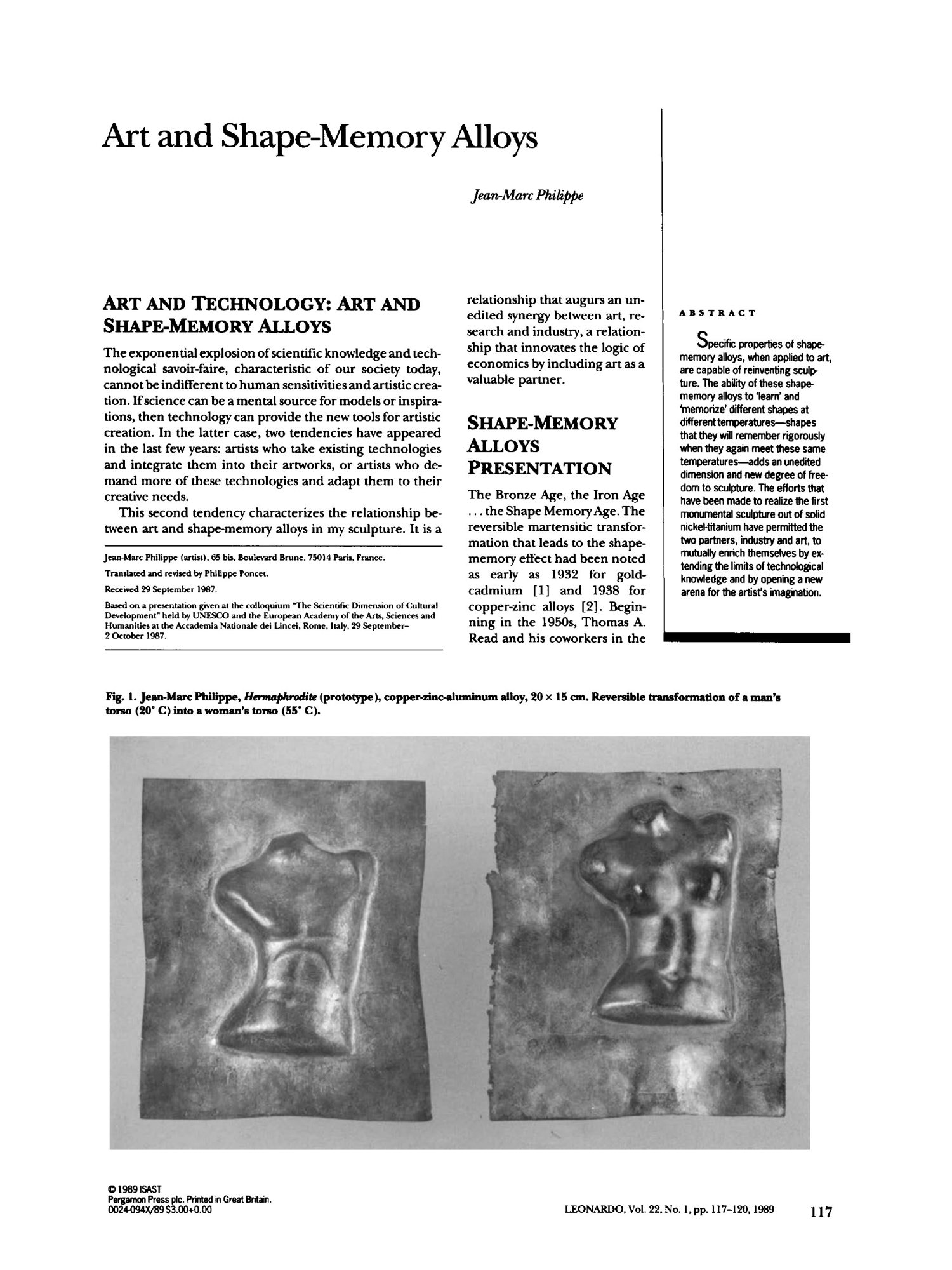
- The reversible transformation of the torso of a man into the torso of a woman, depending upon the temperature: in the shade, it is a man’s torso; in the sun, a woman’s (Fig. 1). For me, this first design was only a stylistic exercise rather than a true artistic creation.
- A replica of the Samothrace Victory that is draped in winter, naked in summer.
- A metallic tree that exhibits living organic behavior: a winter shape, a spring shape, a summer shape … different shapes at different hours. (This was the first draft of L’Arbre de la Nouvelle Alliance, see below and Fig. 2.)
Many other concepts exist in embryonic form in my imagination, but even if they are realistic from a theoretical point of view, they still need to become feasible on a practical level.
The Long Journey to Industrial Savoir-Faire: From Concepts to Realization
Since 1984, I have convinced a number of companies and research institutes in France to participate in my own developing projects and prototypes [5]. High-tech laboratories have been solicited. However, French economic and industrial imperatives have not been compatible with the artistic necessities. Costs are high, small-scale vision is abandoned and large-scale realizations are impossible to build.
In the rest of Europe, Japan and the United States, I knew that research was ongoing, thus I searched for a new and valuable partner. In the United States, Raychem Corporation has had 20 years of experience with shape-memory alloys and has invested large sums of money in fundamental research during this period. Cooperation, dialogue and interaction between artist and industry must be established and a viable economic logic developed. My industrial partner, Raychem, understood that art-based concepts could evolve and be extended to industrial applications and that to invest in sculpture-development projects thus could prove valuable in the future.
My first project with Raychem is Hommage à Tinel ou Le Cercle de Vie (Fig. 3). This sculpture has a daily rhythm as well as a seasonal rhythm. It ‘blooms’ into a full circle (5 m in diameter) in summer or on a hot day and collapses into a double circle (2.5 m in diameter) in winter or on a cold night.
A future project will be L’Arbre de la Nouvelle Alliance, a ‘tree’ that will live with the seasons as a vegetal organism (see Fig. 2).
In the spring of 1988, the company Creartech was established as a joint venture between myself and Raychem, its purpose being to assist designers and artists who want to use shape-memory alloys in their artworks [6].
The Present Outlook
The symptomatic relationship of present opportunities in our societies is evidence of the importance of human involvement in bringing together competencies in different fields, here scientific and artistic, and demonstrates that these junctions are possible and fruitful. We must continue to prove the contribution of technology to artistic development and to pave the way for diversified cultural responsibility, not only by going through the standard channels available for decision making and implementation (marketing of the art, company sponsorship, government orders, etc.) but by adopting a viable and mutually enriching thought process, in which art and the supplementary performances it requests can serve as an innovating catalyst for a company, inspiring, for example, new directions for fundamental research.
Fig. 1. Jean-Marc Philippe, Hermaphrodite (prototype), copper-zinc-aluminum alloy, 20 × 15 cm. Reversible transformation of a man’s torso (20 °C) into a woman’s torso (55 °C).
Fig. 2. Jean-Marc Philippe, L’Arbre de la Nouvelle Alliance, computer simulation, nickel-titanium (Raychem). During summer it is approximately 15 m high and 9 m wide. This tree will ‘live’ with the seasons: images left to right show the sculpture’s changes from winter through summer. The tree will also sing, due to the fact that shape-memory alloys have a high sonic damping at cold temperatures and a low damping at warm temperatures.
Fig. 3. Jean-Marc Philippe, Hommage à Tinel ou Le Cercle de Vie, computer simulation, nickel-titanium (Raychem), 5 m diameter in summer, 2.5 m diameter in winter. Reversible transformation of a plane ring (5 m in diameter) into a plane double ring (2.5 m diameter). The sculpture ‘breathes’ with the daily and seasonal temperatures. Image pairs show front and side views (left and right, respectively): (top) summer; (middle) fall; (bottom) winter.
p. 120
References and Notes
- L. C. Chang and T. A. Read, “Plastic Deformation and Diffusionless Phase Changes in Metals — The Gold-Cadmium Beta Phase”, Transactions of the American Institute of Mining, Metallurgical and Petroleum Engineers 191, 47–52 (1951).
- J. Perkins, G. R. Edwards, C. R. Such, J. M. Johnson and R. R. Allen, in Shape Memory Effects in Alloys, J. Perkins, ed. (New York: Plenum Press, 1975).
- Chang and Read [1].
- W. J. Buehler, J. V. Gilfrich and R. C. Wiley, “Effect of Low-Temperature Phase Changes on the Mechanical Properties of Alloys Near Composition TiNi”, Journal of Applied Physics 34, No. 5 (May 1963).
- These include the Centre National de la Recherche Scientifique (C.N.R.S.), Commissariat à l’Énergie Atomique (C.E.A.), Institut National des Sciences Appliquées (I.N.S.A.), Groupe Péchiney, and Souriau.
- Creartech S.A., 2, Boulevard du Moulin à Vent, 95800 Cergy-Saint-Christophe, France.
Transcribed from the original edition (Jean-Marc Philippe archives). © Jean-Marc Philippe / rights holders.