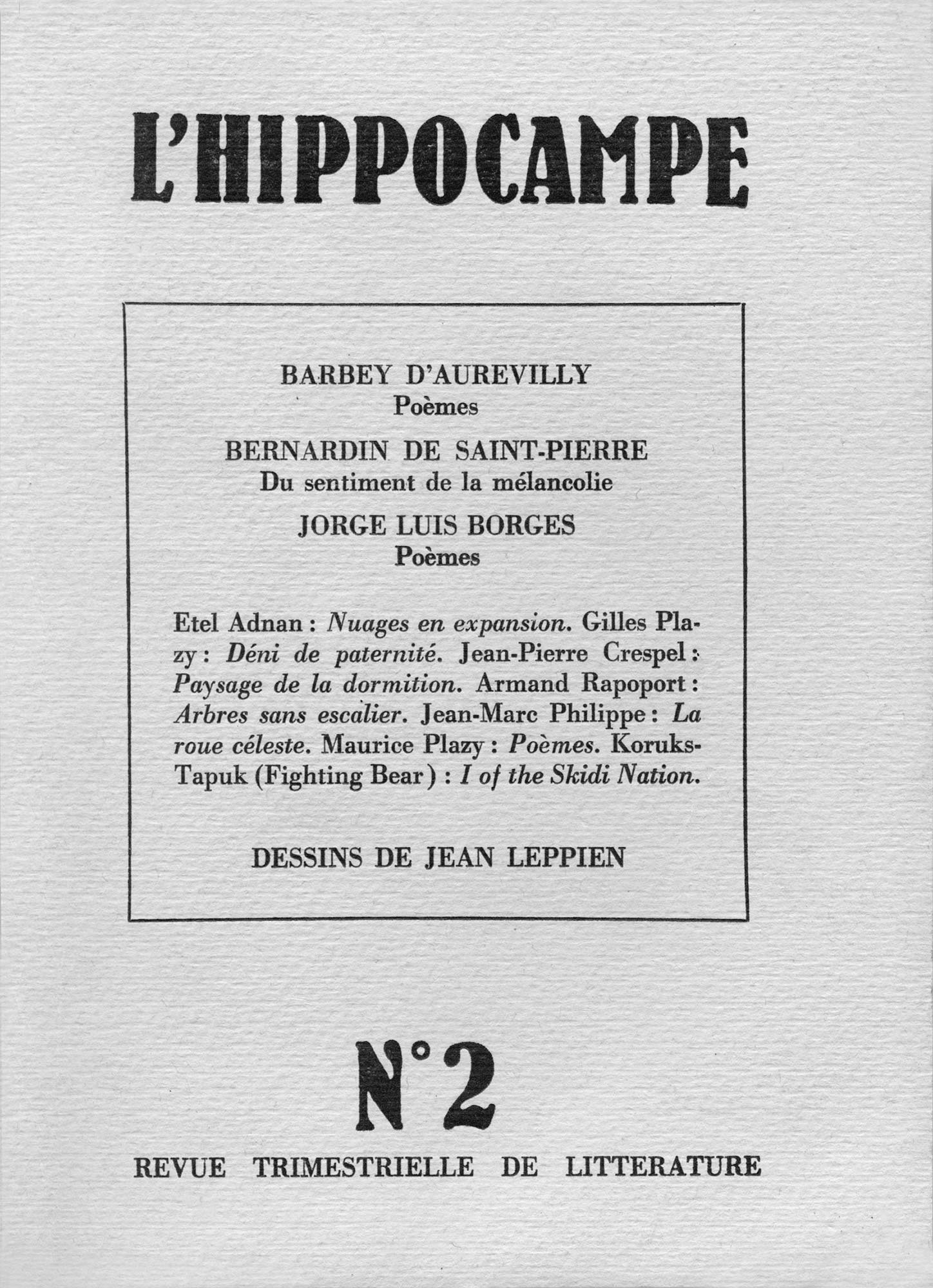
The Celestial Wheel
L'Hippocampe, no. 2, April 1984, pp. 55-58.
p. 55
That night – it will soon be ten years ago – a waking dreamer lying on my back, anchored to the Earth, hands clasped behind my neck, my gaze wandering through the infinity of the constellations, I was possessed by vertigo and bewilderment. It was that time in August when the night sky is a festival, brought alive by a thousand and one shooting stars.
In that moment of rapture – I swear it – I was floating, wholly, in the midst of the stars. And it was then, at the edge of my field of vision, in the changelessness and immensity of a boundless silence, still lit by a sun that had nonetheless set long before, that, twinkling like a star of the first magnitude, an artificial satellite in low orbit made its entrance, setting out to cross the celestial vault diagonally until, a few moments later and still in that unheard-of silence, it vanished, swallowed by the cone of the earth's shadow.
That evening, the poem was the entire universe and the “I” of the poem that artificial star: now man was inscribing his trace upon the background noise of the firmament and, having conquered the infinitely small, he was now undertaking – this man – to push open with his frail little arms the doors of the infinitely large.
At that very instant, I knew that Science had
p. 56
become subject in Discourse: the “objects” it would reveal would one day be initiatory.
Chronologically, the concept of what was to become the Celestial Wheel arose from a diffuse longing bound up with the memories of that night, and then from a succession of opportunities and data closely related to the advances in technological know-how made in the course of the Conquest of Space.
The Celestial Wheel rests essentially on the notion of the geostationary satellite. Hundreds of these satellites are already in space, but what matters to us here is that ALL geostationary satellites are located on one and the same orbit and that this orbit is a CIRCLE – and not just any circle, since it is a circle concentric with the circle of the terrestrial equator, in the same plane, and whose radius is seven times greater than that of the Earth. In other words, all geostationary satellites are arranged on a kind of ring of Saturn (that famous circle) surrounding the Earth, a ring whose diameter measures nearly 90,000 km.
Another characteristic of this type of satellite is that they remain fixed in the sky, that is to say they rotate at exactly the same angular velocity as the Earth.
Because of the preceding characteristics, the idea was therefore to consider grafting onto the next satellites of this type (sixty are to be launched between now and 1989) a technical device capable of emitting, on command from the ground, a light signal which, seen from the Earth, would have a magnitude (a brightness) equal to or greater than that of Venus at its maximum brilliance.
Thus, once at least thirty of these future satellites had been “rigged” with the appropriate devices (they
p. 57
are being studied in France and in the United States), it would be possible to “switch them on” all together, and they would then draw in the sky a kind of gigantic… celestial wheel.
Various lighting configurations are possible: the whole might, for example, blink like a garland or else, through the programmed and successive lighting of the satellites, this great circle would give the impression of turning. Many other luminous combinations are conceivable and, in the sky of the stars, human genius would inscribe no longer a trace but a sign.
Out of respect for the stars, this signal from humankind to humankind could be activated – once a consensus had so decided – for five seconds every day at 0 h. UT, 8 h. and 16 h. UT. The Celestial Wheel would then be a universal time signal visualising the plane of the terrestrial equator.
On certain world occasions (Olympic Games, World Fair…) one might also consider making the Celestial Wheel blink every three hours for as long as these events lasted, as a sign that somewhere, at that moment, on Earth: Celebration… And then, if by misfortune a nuclear conflict were one day to break out, the Celestial Wheel would be called upon to pulsate, emitting a luminous S.O.S. in Morse code.
Finally, let us note that, depending on the latitude of the place from which it was observed, it would be perceived in radically different ways: seen from the equator the Celestial Wheel would be vertical, and its inclination would increase until it became horizontal as one “climbed” towards one of the poles.
A beacon in space, a signal without precedent, the Celestial Wheel was conceived as a tangible and revealing symbol
p. 58
of our own new dimension as human beings at the close of the 20th century: the dimension of our capacity for know-how, of our capacity to ask ourselves new questions and to steer a survival raft in space, a certain blue pearl in the cosmos: a planet called Earth.
At the crossroads of Art, Banking and Industry, the Celestial Wheel embodies and illustrates the advent of the tremendous change of civilisation that lies ahead. Its premises no longer belong to the classical artistic approach, and its realisation involves the whole community. Its financing will be proof that a cultural will has succeeded in bending the traditional nature of investment – an investment that would no longer fall within the framework or the perspective of the industrial model alone but would apply, this time, to the things of the mind.
A signal to be decoded by analogy, clothed and inhabited according to each person's subjectivity, the Celestial Wheel is one of those artefacts accomplished enough to convey by themselves the feeling of their own Desire.
Charged with a poetic force without equal, it represents and expresses for me the change of scale in the history of humankind. And then, above all – perhaps here I am fantasising – I would like it to cry out that the time of the prophets is over, that the prophet is you, is me, that we are in an era in which the consciousness of being is now the whole of humanity, and that this whole of humanity rests on the sum of all our individual acts, our commitments, our abdications, our aspirations, our demands, and that it is all of this, taken together, that sculpts the true face of the Earth. As I said: I am fantasising, and yet I would believe it – the Celestial Wheel partakes of the Sacred, whose Subject is Science.
Transcribed from the original edition (Jean-Marc Philippe archives). © Jean-Marc Philippe / rights holders.