KEO is a project by Jean-Marc Philippe, conceived in 1994: a satellite carrying the messages that the inhabitants of the Earth wish to send to their very distant descendants, intended to return to Earth after 50,000 years in orbit. Jean-Marc Philippe worked on it until his death on 12 November 2008.
The project extends the operation Messages from Humankind to the Universe: in 1986 – 1987, 10,500 messages collected via Minitel were transmitted on 26 January 1987 by the Nançay radio telescope towards the heart of the galaxy. KEO reverses the gesture: the messages no longer travel towards hypothetical others, but towards our own descendants.
The idea
The figure of 50,000 years is not arbitrary: it is the mirror date of the appearance of art, which bears witness to the human capacity for symbolic representation. So dizzying a span of time compels everyone to leave their everyday frames of reference behind and places all the authors of messages on an equal footing. The name KEO is formed from three sounds, [k], [e] and [o], among the most frequent in the most widely spoken languages: it can be pronounced in every culture and refers to no mythology.
The satellite
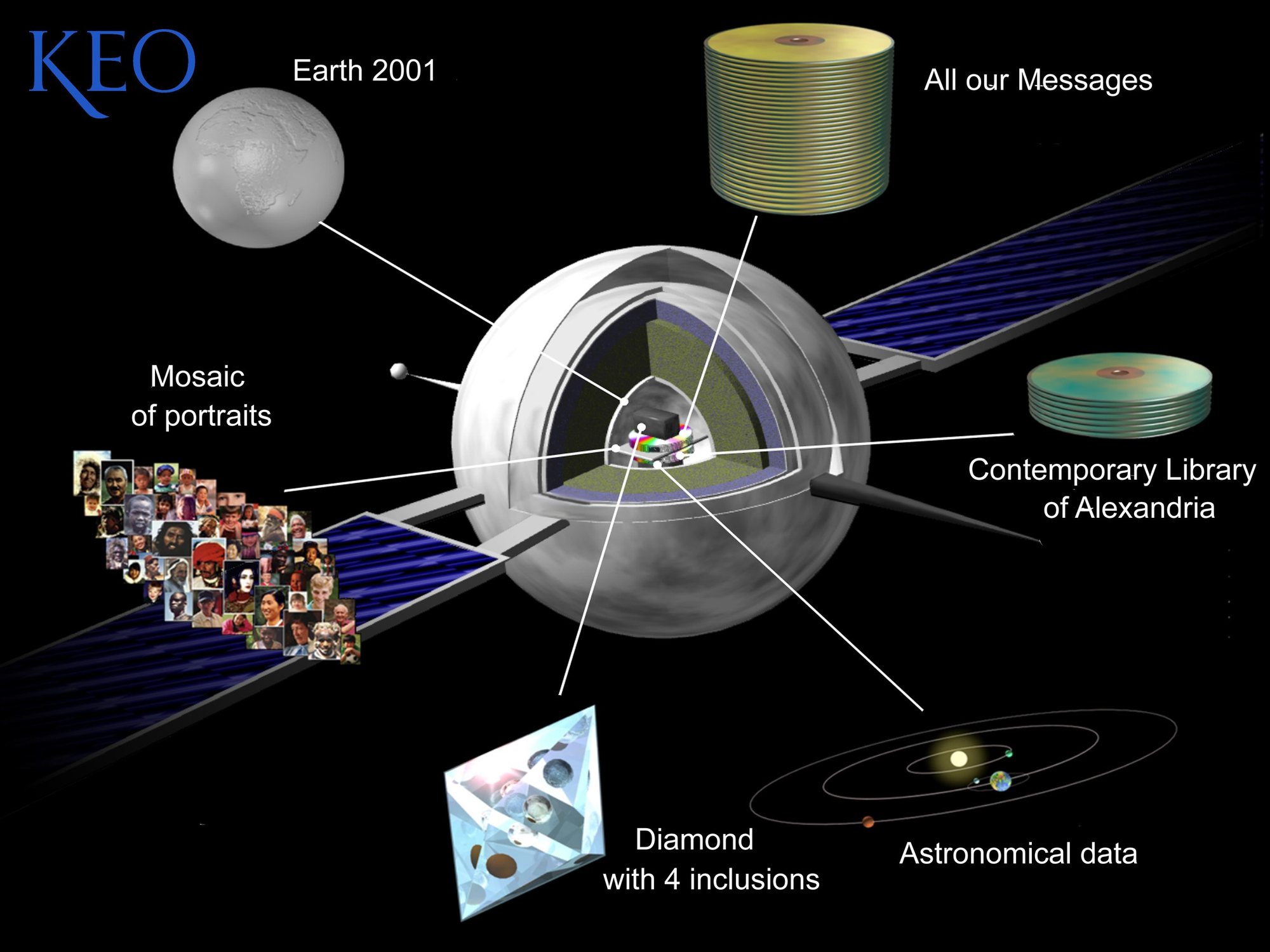
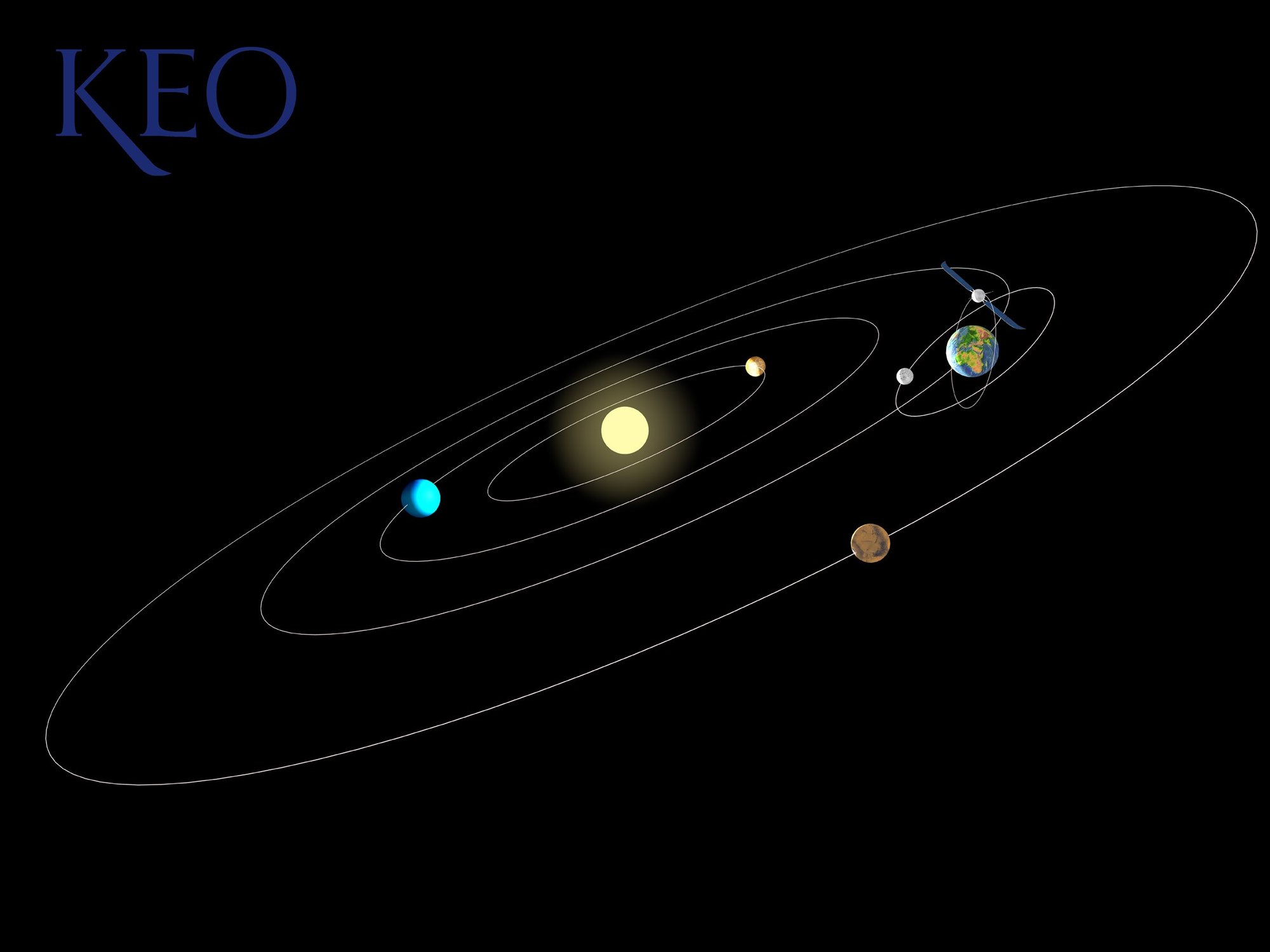
KEO is a titanium sphere less than 80 centimetres in diameter, engraved with an image of the Earth. Two large wings give it a span of 9 metres. Over the course of studies carried out with the French and then the European space industry, its mass was brought down to less than 100 kg, ejection system included. It is passive: no source of energy, no instruments on board. It obeys only the laws of ballistics, the attraction of the Earth, the Moon and the planets, the pressure of sunlight and the drag of the residual atmosphere. At an altitude of about 1,800 kilometres, it would be observable with powerful telescopes.
It was to be launched as a secondary passenger on an Ariane rocket. Folded beneath the fairing, its wings unfold in orbit, then beat each time it passes from the Earth's shadow into the light, thanks to shape-memory alloys and without any energy: they evoke a messenger bird. On its return, KEO would cross the atmosphere protected by several shields (thermal, shock, meteorite and debris, cosmic radiation) made of titanium, tungsten and aluminium separated by vacuum. Shortly before landing, the disintegration of its outer shields would create an artificial aurora borealis in the sky, the signal of its return.
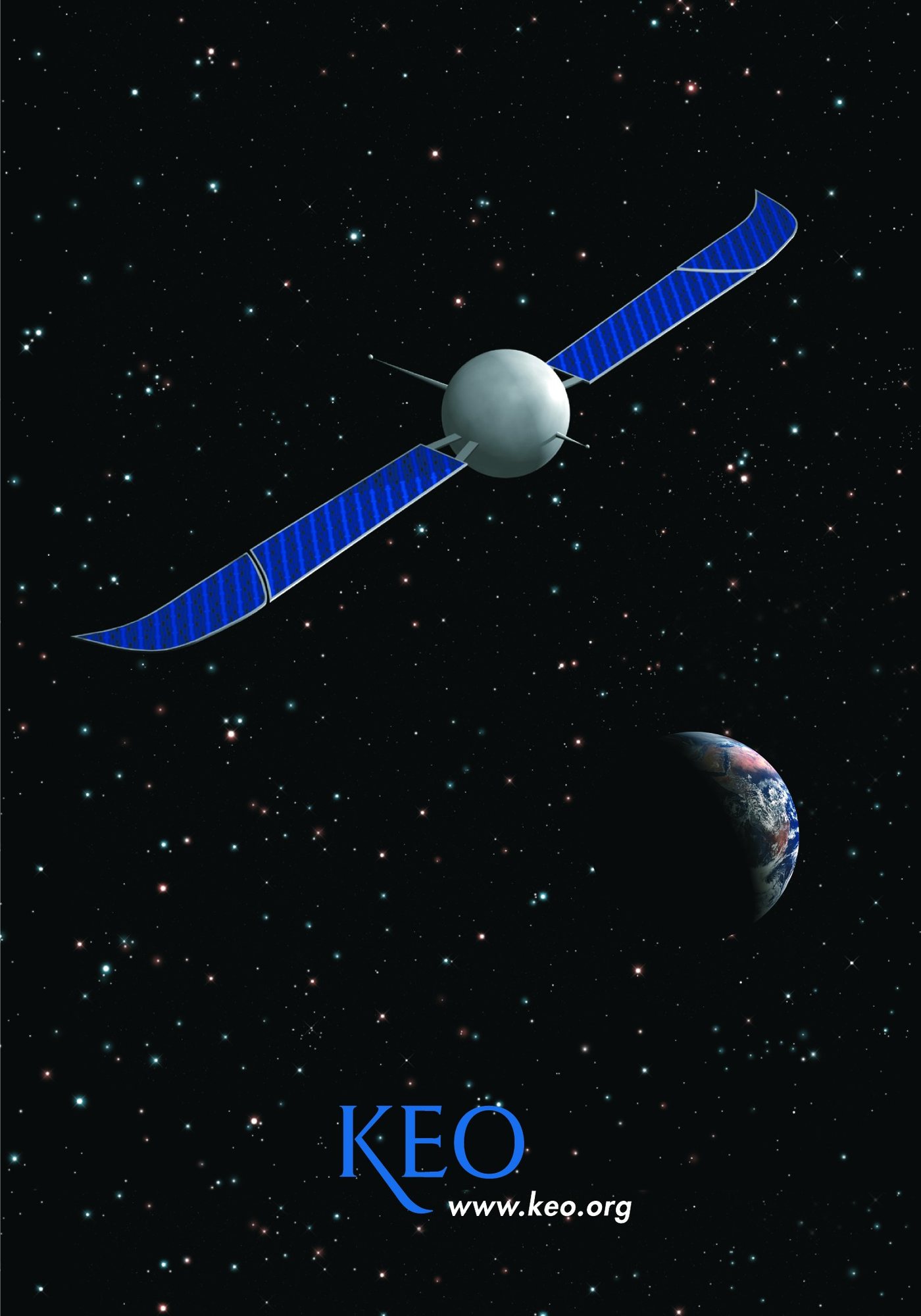
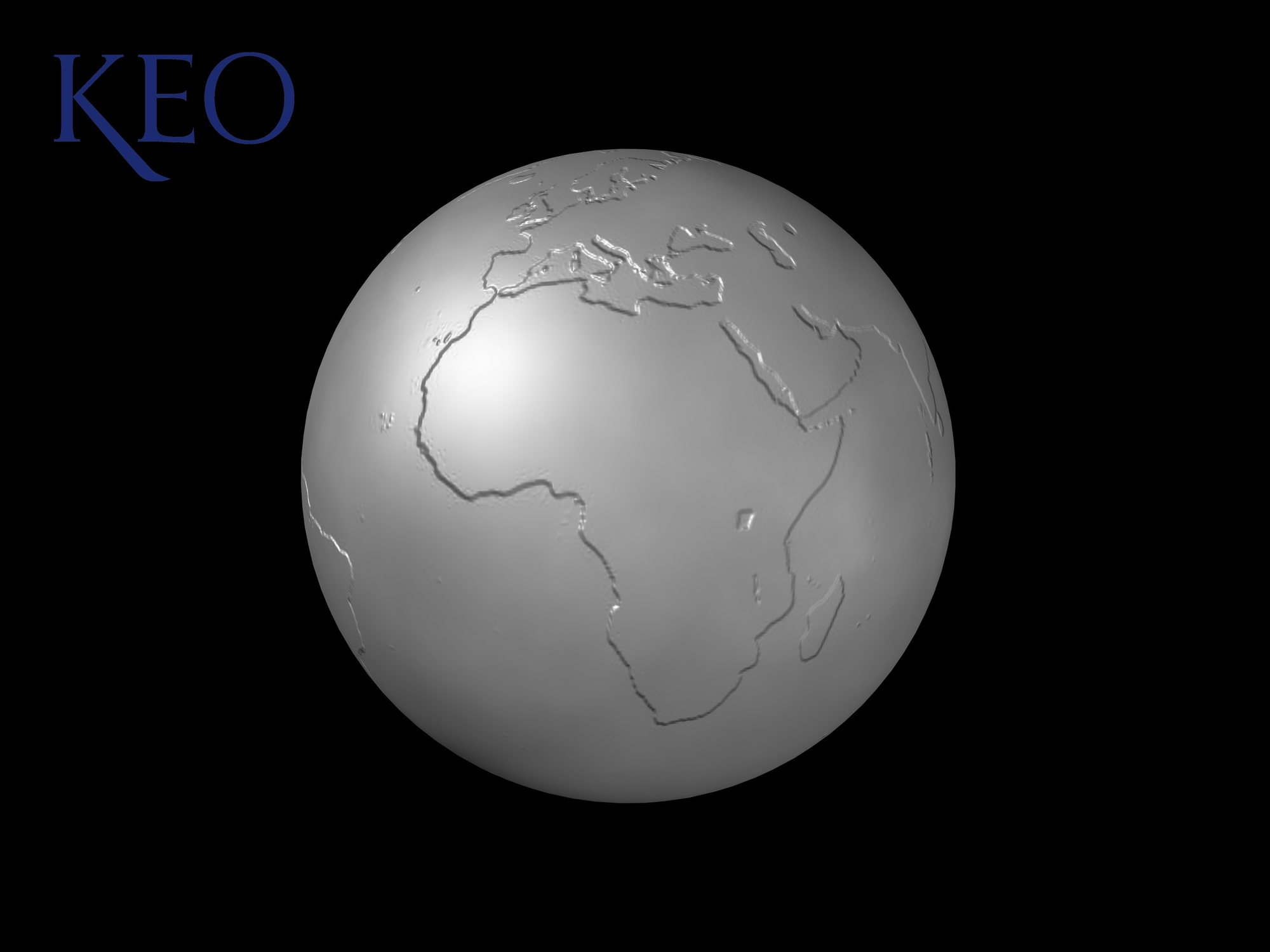
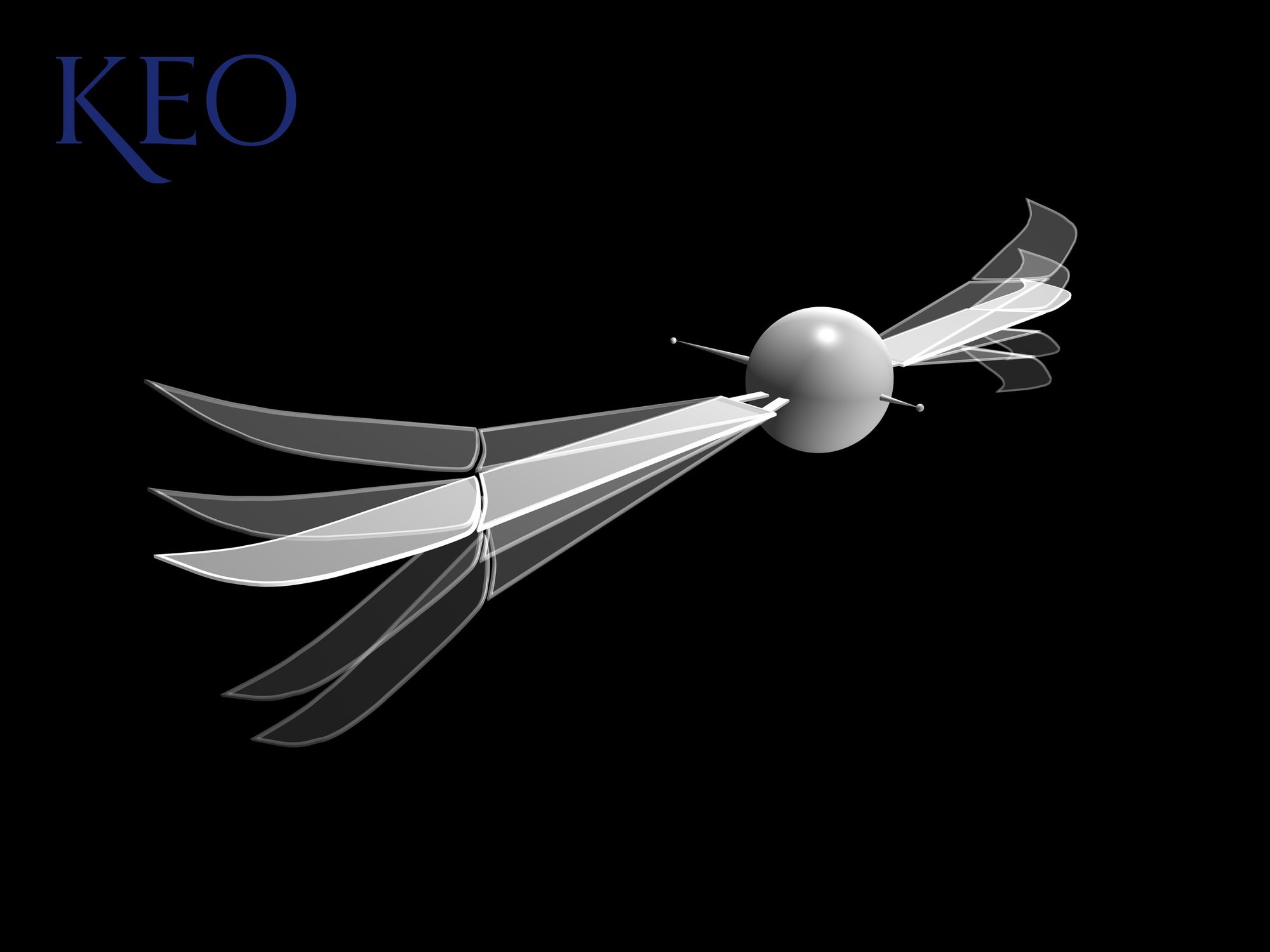
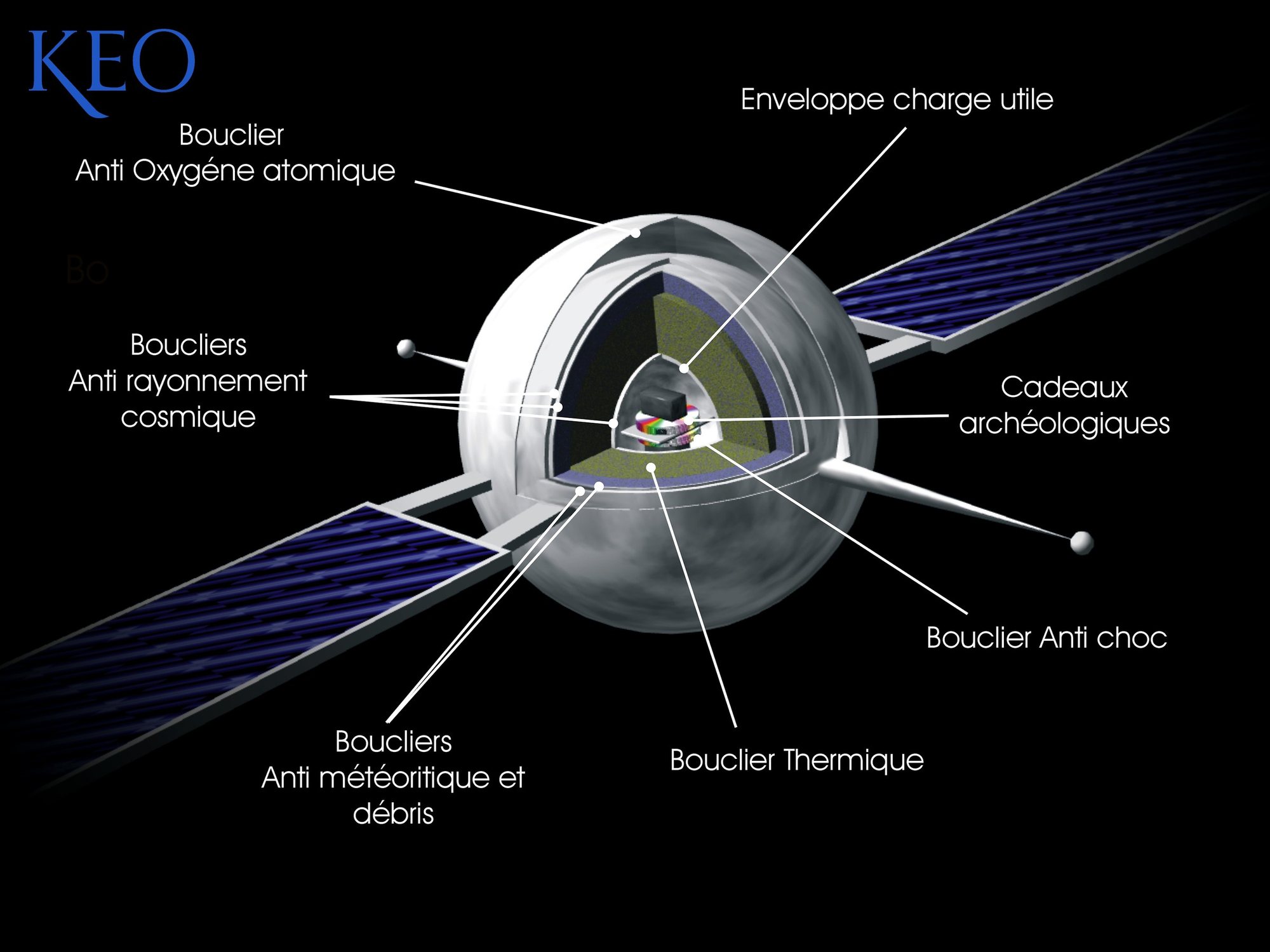
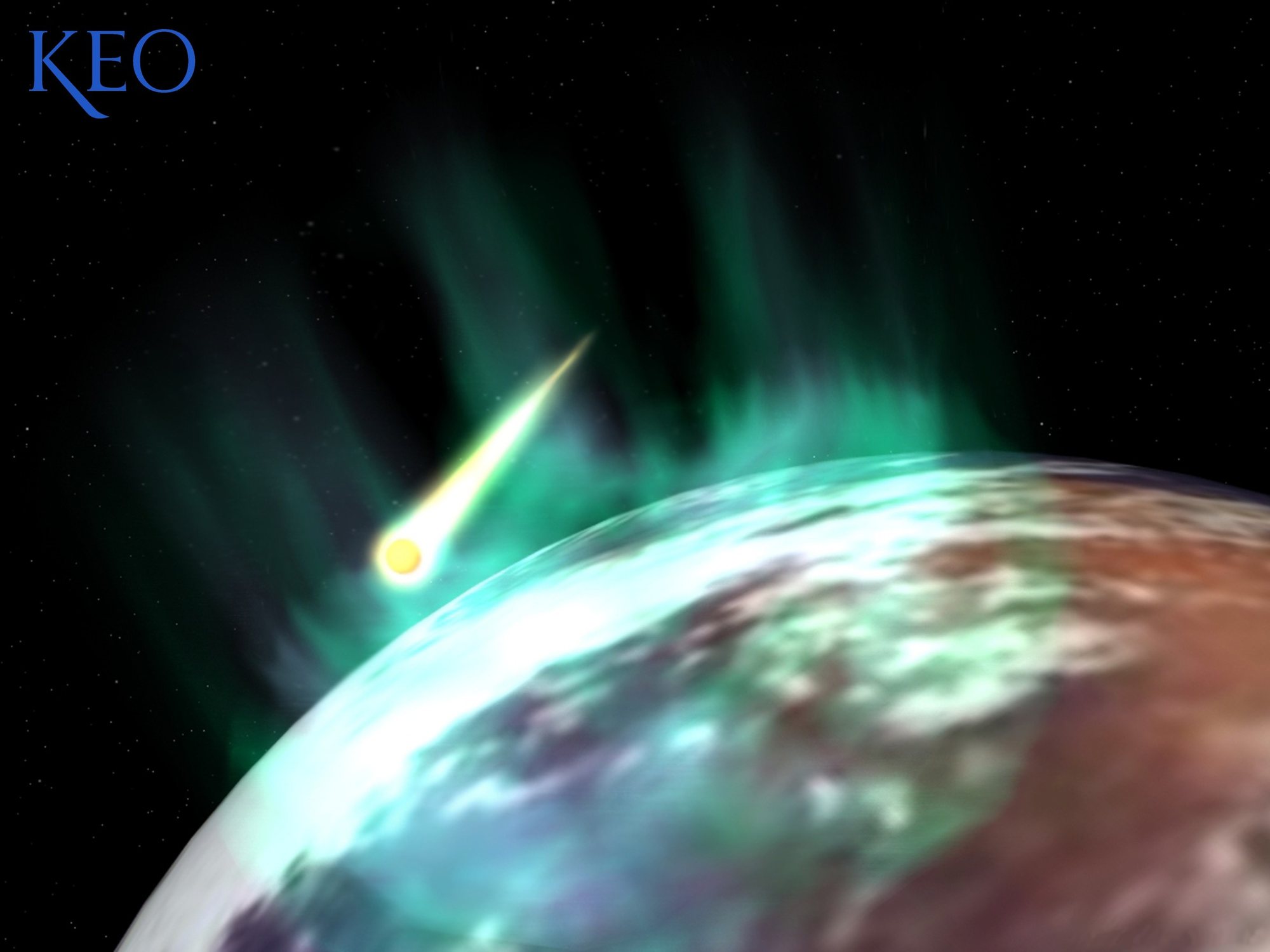
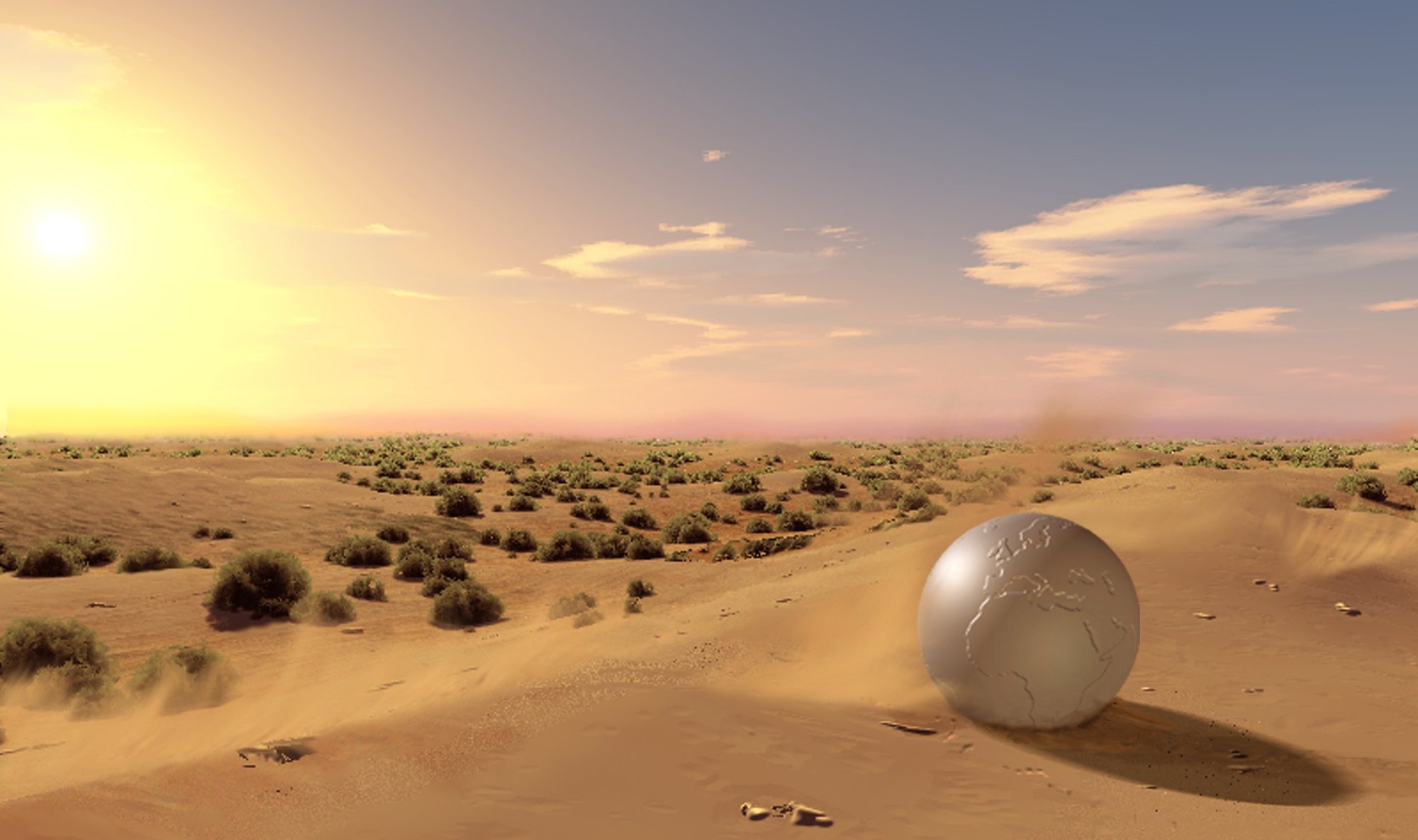
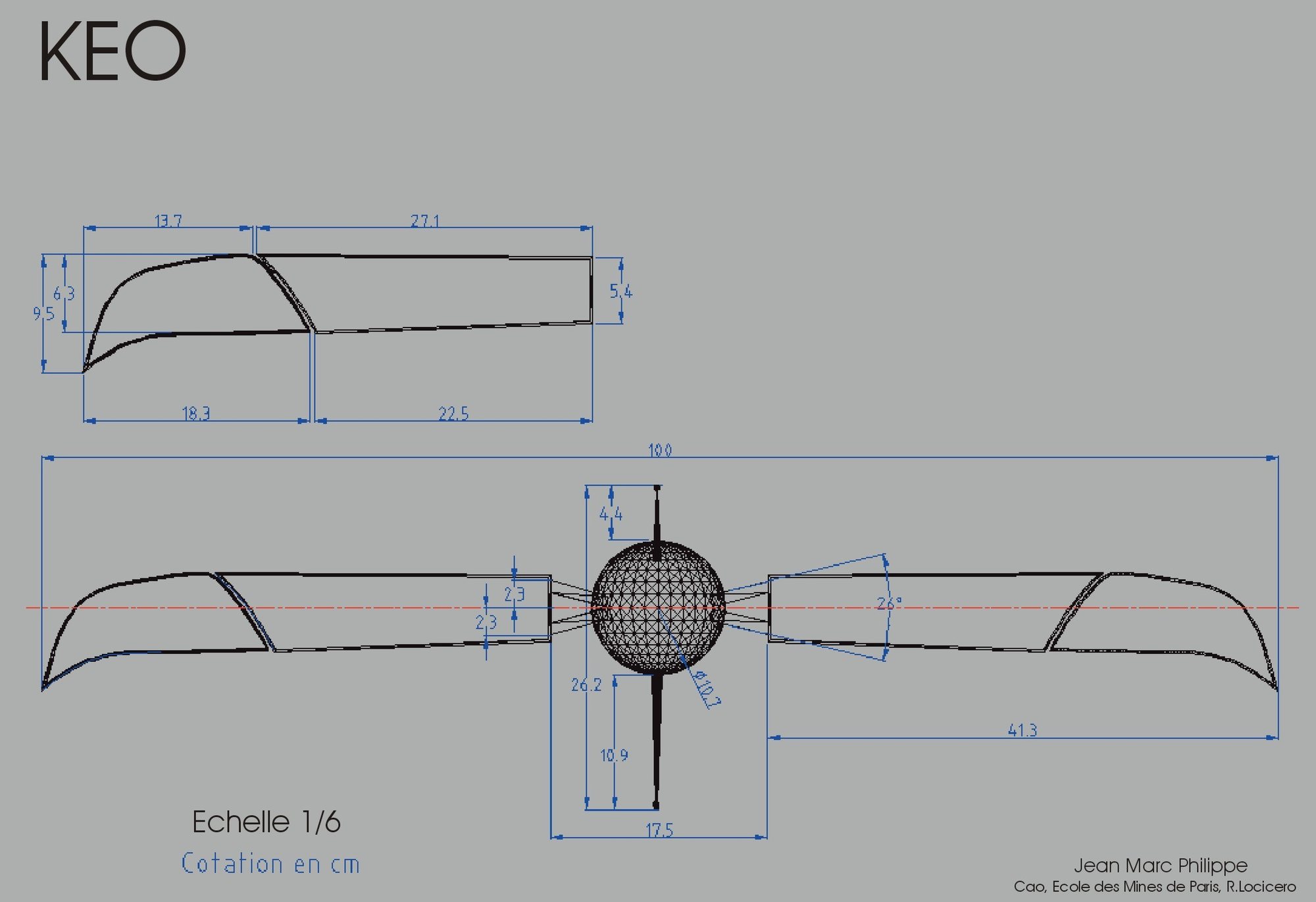
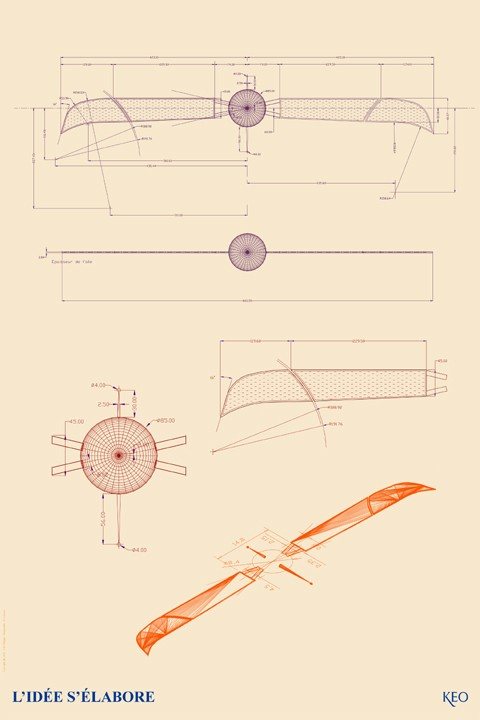
Official images of the KEO project and technical drawings of the satellite.
The archaeological gifts
KEO carries several sets of objects, designed to be discovered and then deciphered:
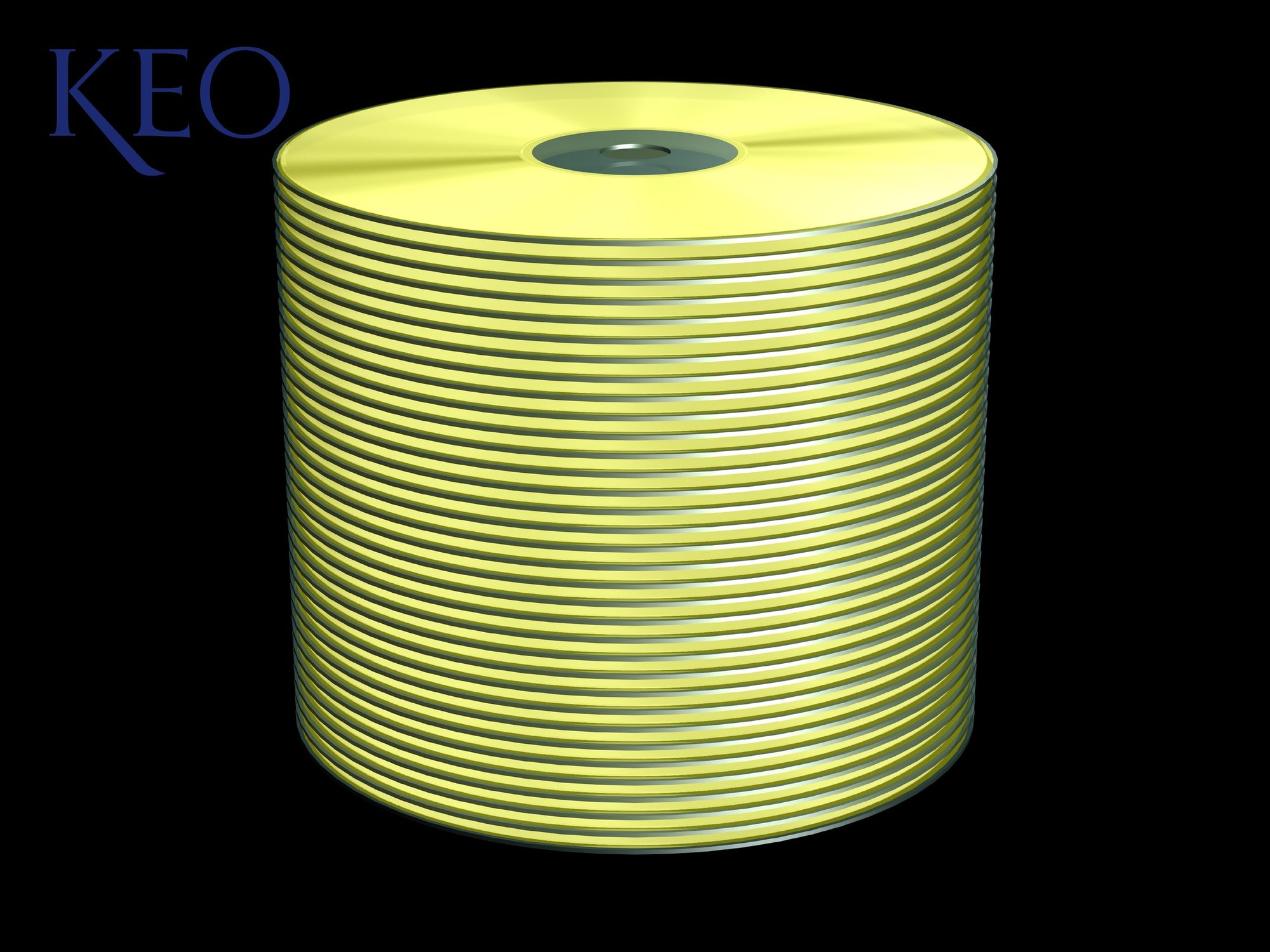
- a stack of laser-engraved glass discs bearing the messages of the inhabitants of the 21st century;
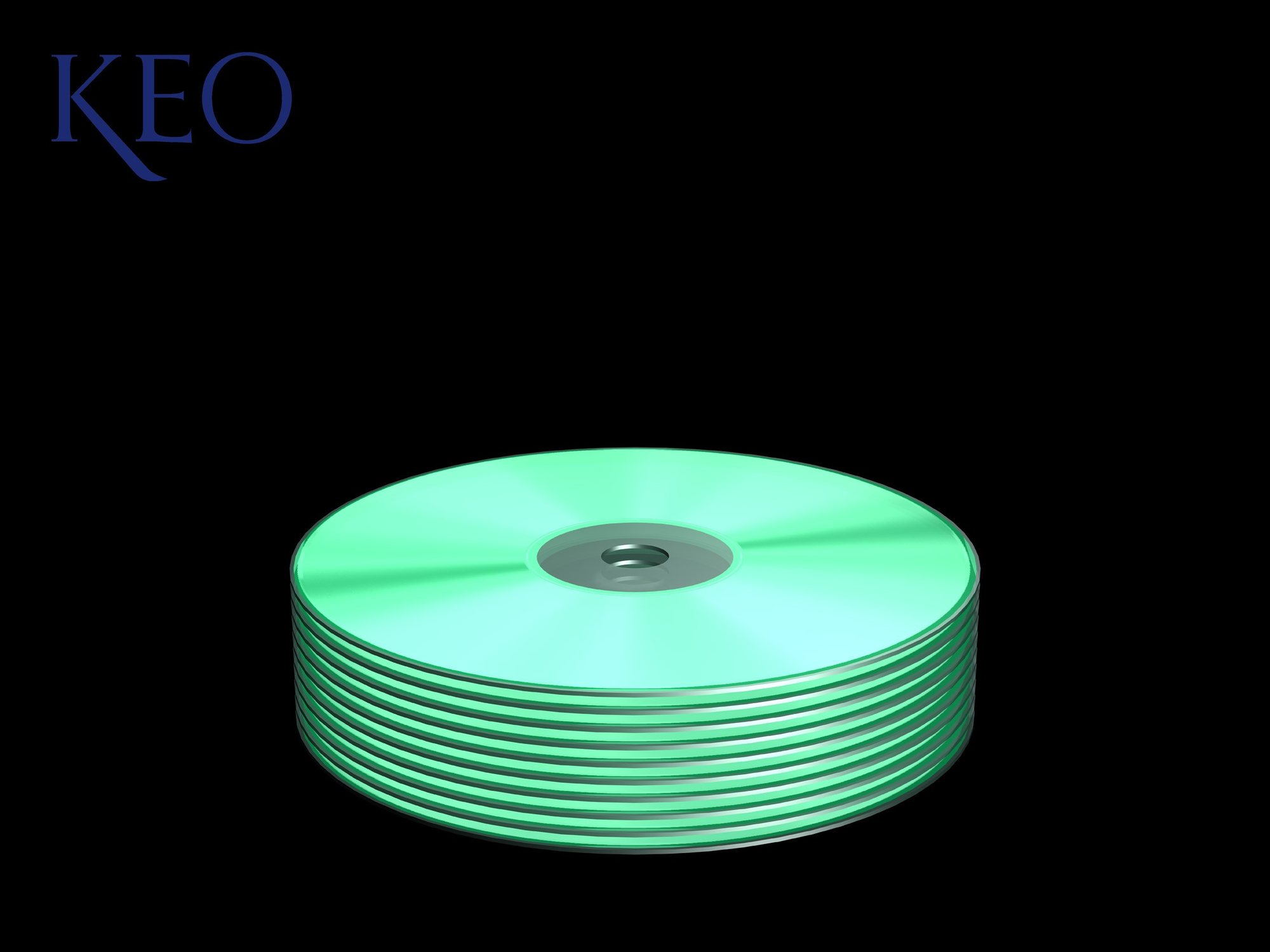
- a second stack, the “contemporary Library of Alexandria”, a record of the knowledge of our time (arts, learning, traditions, geopolitical situations) in texts, images and sounds;
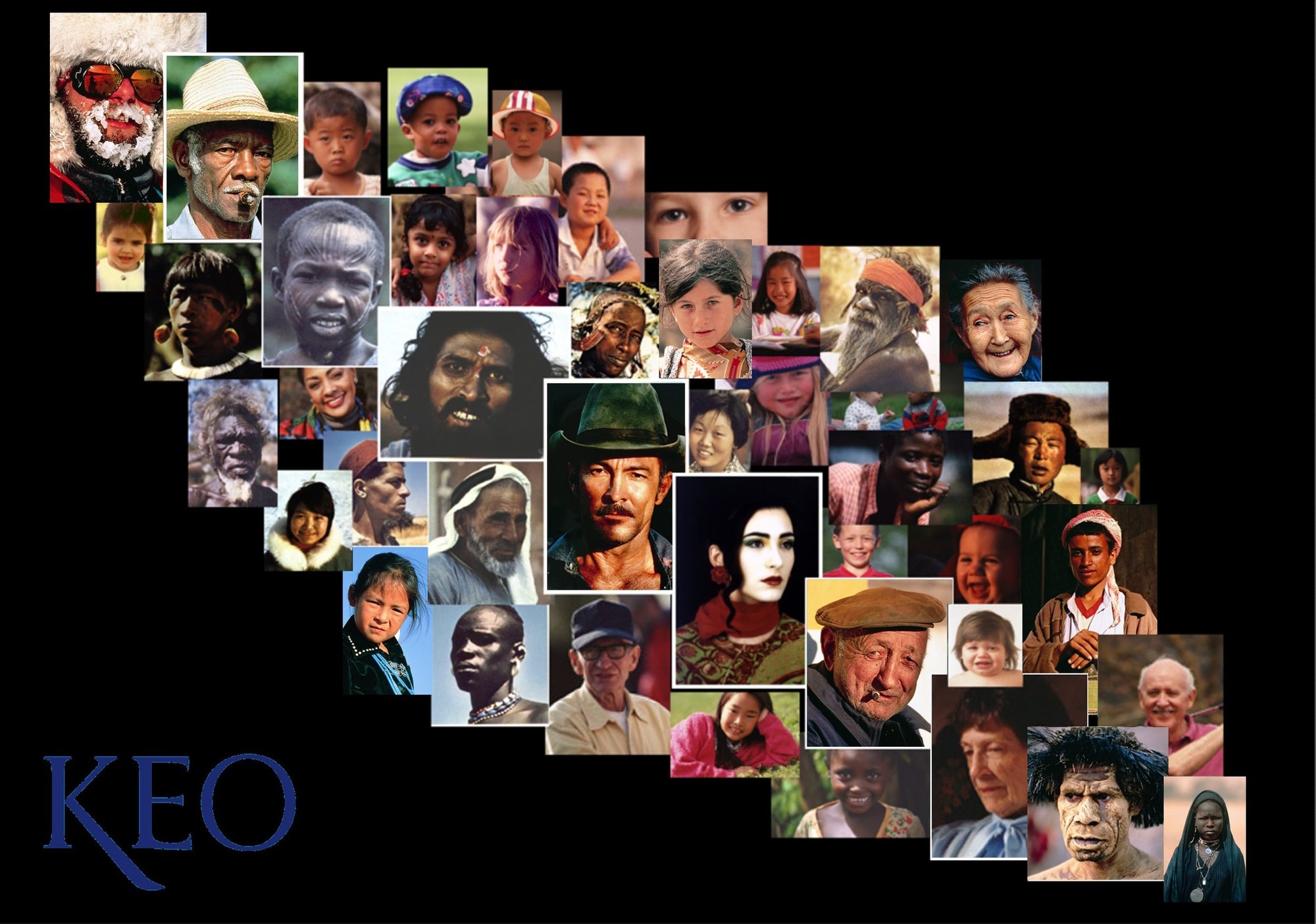
- a mosaic of the faces of men, women and children, with a sequence of human DNA;
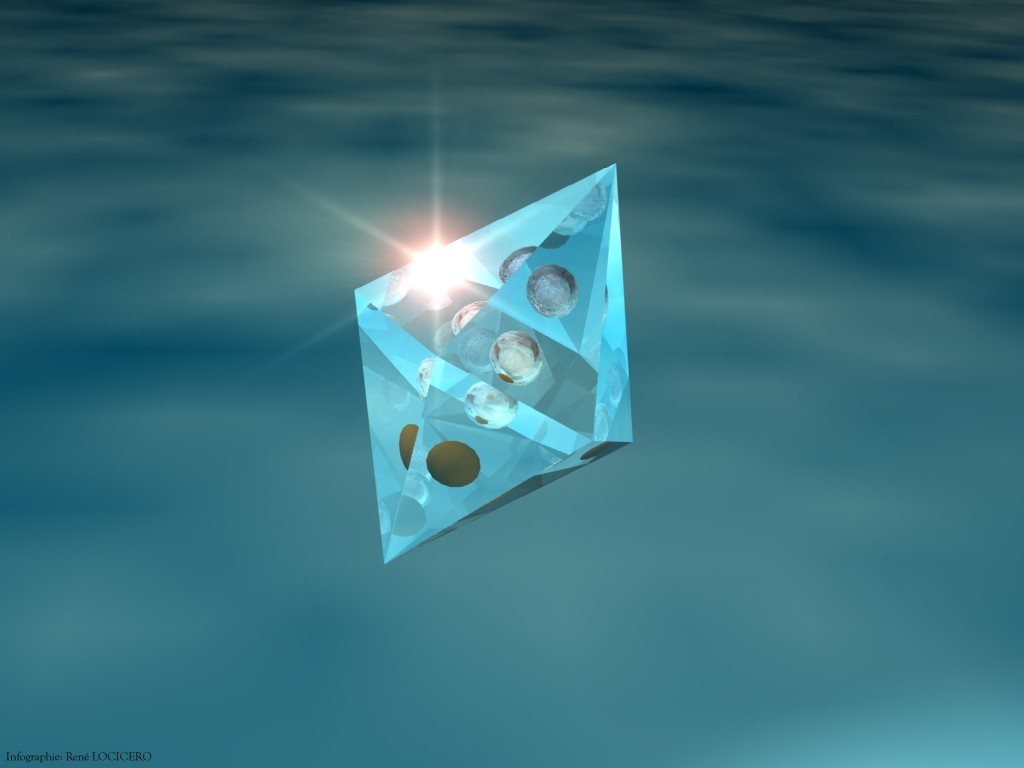
- a diamond with four inclusions of gold spheres: water, earth, air and a drop of human blood;
- a sidereal clock fixing the position of the planets at the moment of launch, so that it can be dated;
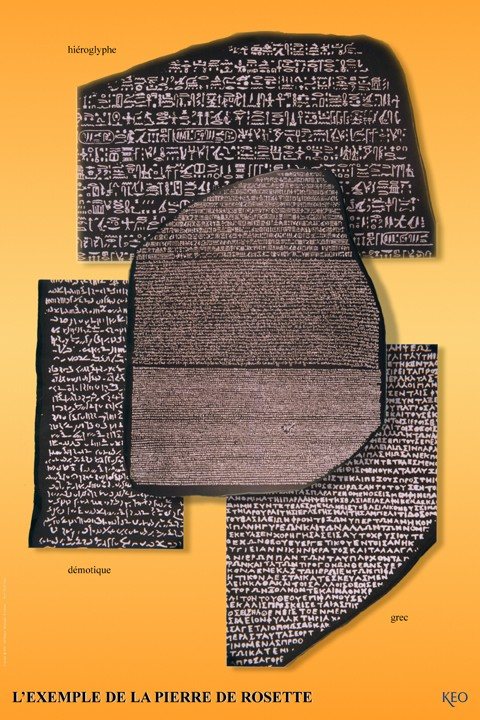
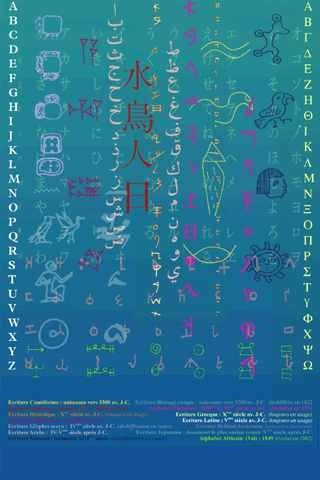
- reading keys: instructions in symbolic terms for building a disc reader, after the example of the Rosetta Stone, and a disc to be read with a tuning fork.
In July 1998, at GANIL in Caen, the discs were exposed to the equivalent of 50,000 years of cosmic radiation: they remained intact.
The messages
Every inhabitant of the Earth could write a message to KEO, free of charge, in the language of their choice, from a single line up to 6,000 characters, or four pages: “four pages of freedom and equality”. Only texts were accepted, so that no one would have more means than anyone else, and there was no censorship. Messages were sent by Internet or by post; those who cannot write could dictate their message to someone close to them, and volunteer collectors, the Keonauts, gathered those of oral cultures.
After the launch, the messages were to be made anonymous, then made freely accessible and analysed, country by country, age by age, language by language, in order better to understand what the humans of today say about themselves.
A worldwide collection
From 1997 onwards, Jean-Marc Philippe and the KEO Programme association presented the project at congresses, exhibitions and collection campaigns in France and around the world. The education ministries of several countries circulated a teaching guide translated into eleven languages. Messages came from more than 200 countries; at the beginning of 2007, China led in the number of messages, ahead of the United States, India, Canada and Mexico, and Réunion Island in the rate of participation.
Chronology
| 1994 | Paris — Jean-Marc Philippe completes the formulation of the idea of KEO. |
|---|---|
| May 1997 | Paris, UNESCO — Exhibition “Les sciences dans l'art”: first presentation of the model of KEO. |
| October 1997 | Turin (Italy) — 48th International Astronautical Congress: presentation of the feasibility study. |
| 1998 | Paris, Cité des sciences et de l'industrie — Exhibition (20 June – 1st September). |
| July 1998 | Caen, GANIL — The glass discs are subjected to the equivalent of 50,000 years of cosmic radiation: they remain intact. |
| 1999 | Toulouse, Cité de l'espace — Opening of a permanent exhibition (14 May). |
| 1999 | Vienna (Austria); New Delhi (India); Paris, UNESCO — Model presented at UNISPACE III (UN), at the Space 99 fair and at the exhibition “Partenariats pour le XXIe siècle”. |
| 2000 | Hanover (Germany); Brussels — World Expo, French pavilion; “Prélude à l'envol de KEO”, Brussels Town Hall, French presidency of the European Union. |
| December 2000 | Paris, UNESCO — Evening event “Postésie 2000, du Vélo à KEO”, devoted to the safeguarding of languages around a poetry competition. |
| 2001 | Athens and Delphi; Asunción (Paraguay) — World Poetry Day (Cultural Olympiad); day of message collection at the French Embassy. |
| 2001 – 2003 | Quebec City (Canada), Musée de la civilisation — “Prélude à l'envol de KEO”: an exhibition of about 1,000 m², produced with the Musée du Louvre, which lent 51 works. |
| March 2002 | Réunion — The teaching kit is distributed to every school. |
| September 2002 | India: New Delhi, Calcutta, Chennai, Bangalore, Hyderabad, Bombay — Presentation tour, press conferences, schools and universities; posters measuring 15 by 5 metres in Bombay. |
| July 2003 | Paris — Analysis of a sample of 100,000 messages by the company Lingway. |
| September 2003 | Plovdiv (Bulgaria) — A 400 m² exhibition at the International Technical Fair: more than 21,000 visitors. |
| 2004 | Strasbourg; Dakar (Senegal); Belgium, Euro Space Center — Presentation at the Council of Europe; study trip to Senegal; exhibition at the Euro Space Center (2004 – 2006). |
| December 2004 | Beijing (China) — Formation of the KEO China Committee. |
| February 2005 | Tehran (Iran) — Press conference, television programmes; teaching guide translated into Farsi. |
| May and September 2005 | Alexandria and Cairo (Egypt) — Lectures at the Bibliotheca Alexandrina; launch of the campaign towards the Arab world and first poster in Arabic. |
| June 2005 | Vienna (Austria), UN — Presentation before the Committee on the Peaceful Uses of Outer Space, at the invitation of ESA and Belgium. |
| November 2005 | Brussels — “Fête du Roi” (King's Day) devoted to space, at the Palais de la Nation. |
| Dec. 2005 – April 2006 | Mexico City, MUTEC — A 500 m² exhibition, opened on 7 December in the presence of Jean-Marc Philippe: 2,000 to 3,000 pupils a day. |
| January 2006 | Damascus (Syria) — Press conference at the National Museum; the exhibition planned for the spring is cancelled because of the war in Lebanon. |
| 2006 | Beijing; Tehran; Mexico City — Campus activities by the KEO China Committee; stands during Space Day in Tehran; schools and the Human Rights Fair in Mexico City. |
| 2007 – 2008 | Mexico: León, Mexico City, Pachuca — Exhibitions at the Explora museum (León), in the “Tunnel of Science” of the Mexico City metro (about 100,000 visitors a day) and at the El Rehilete museum (Pachuca), with messages from the Hñähñu community. |
| 12 November 2008 | Death of Jean-Marc Philippe. |
| April 2009 | Malmedy (Belgium) — Operation “Who Are You?”: more than 250 children write their message. |
| 22 November 2012 | Paris, UNESCO — Presentation of KEO; the International Fund for the Promotion of Culture announces that it is taking up the torch. |
| December 2013 | Guyancourt, lycée de Villaroy — A message urn placed beneath the spiral clock designed by Jean-Marc Philippe. |
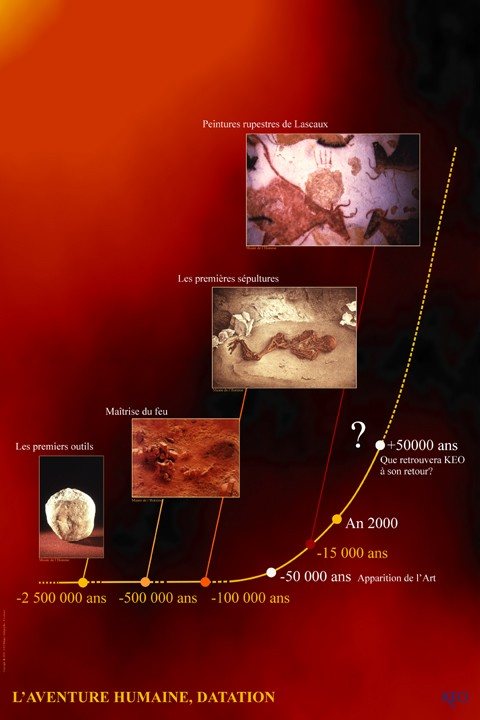
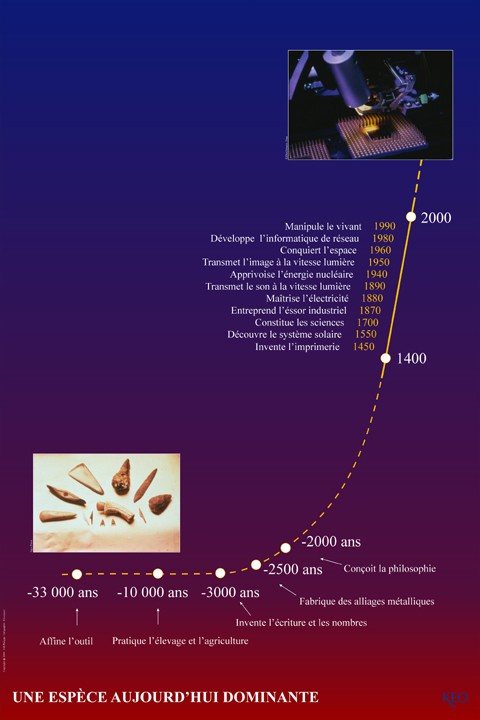
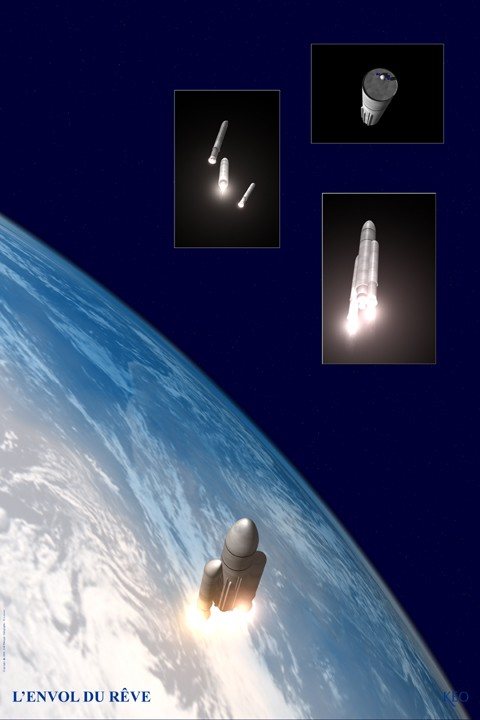
Panels from the KEO catalogue and exhibitions.
UNESCO
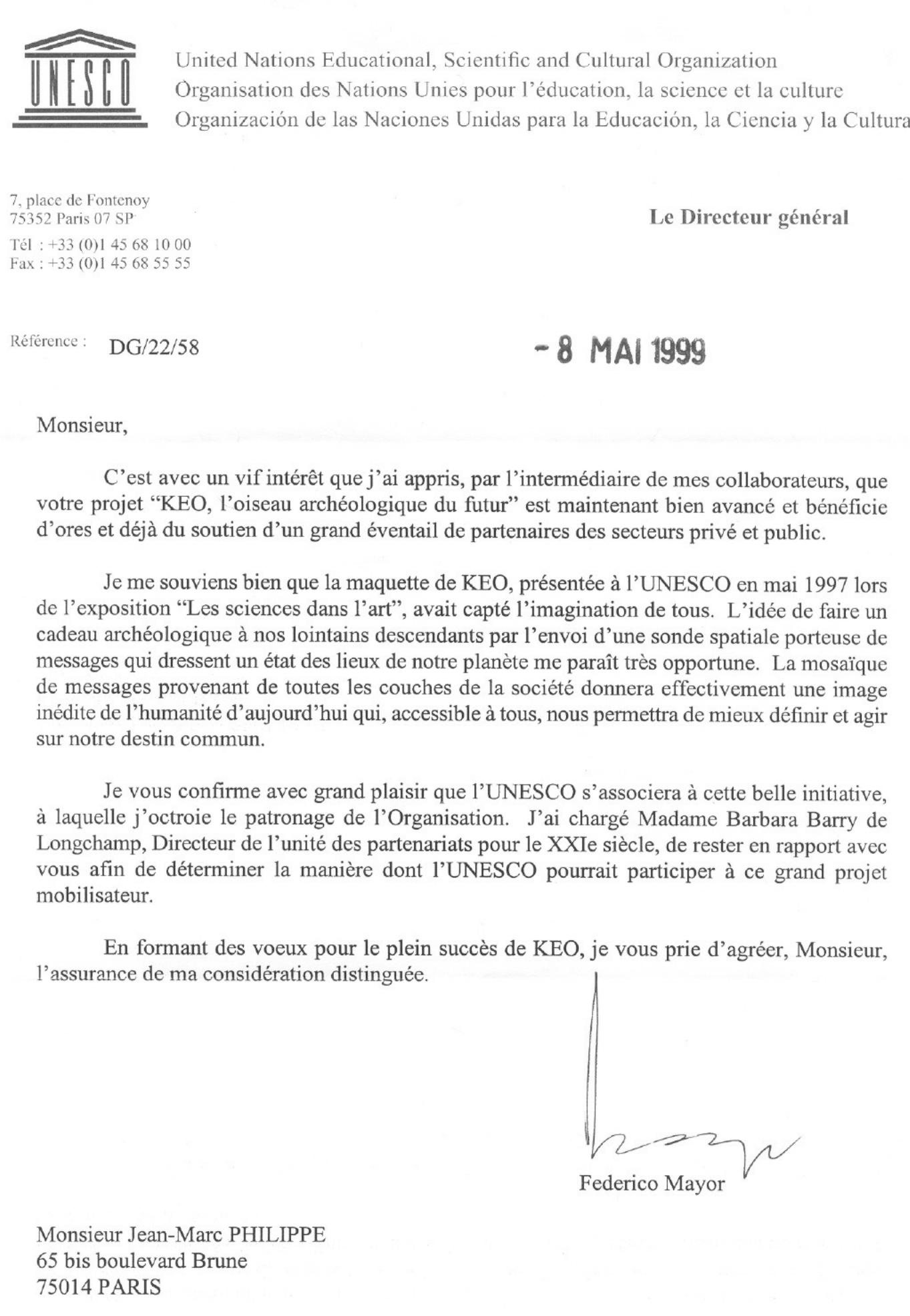
On 8 May 1999, Federico Mayor, Director-General of UNESCO, granted KEO the patronage of the Organization: “The idea of making an archaeological gift to our distant descendants by sending a space probe carrying messages that take stock of our planet seems to me most timely.” He had discovered the model in May 1997, at the exhibition “Les sciences dans l'art”, and selected KEO as a “21st-Century Project”.
A launch postponed again and again
Several dates were announced, from late 2003 to 2018. The project relied on donated expertise, and those in charge of it explained the postponements by the restructuring of the space industry at the end of the 1990s, the space recession of 2000 to 2002, the attacks of 11 September 2001, the reorganisation of CNES, the failure of an Ariane 5 launch in December 2002 and the flagging commitment of certain partners. In 2019, the president of the association acknowledged that this model was no longer viable: what was needed was a moral sponsor, a few patrons and companies under contract.
The partners
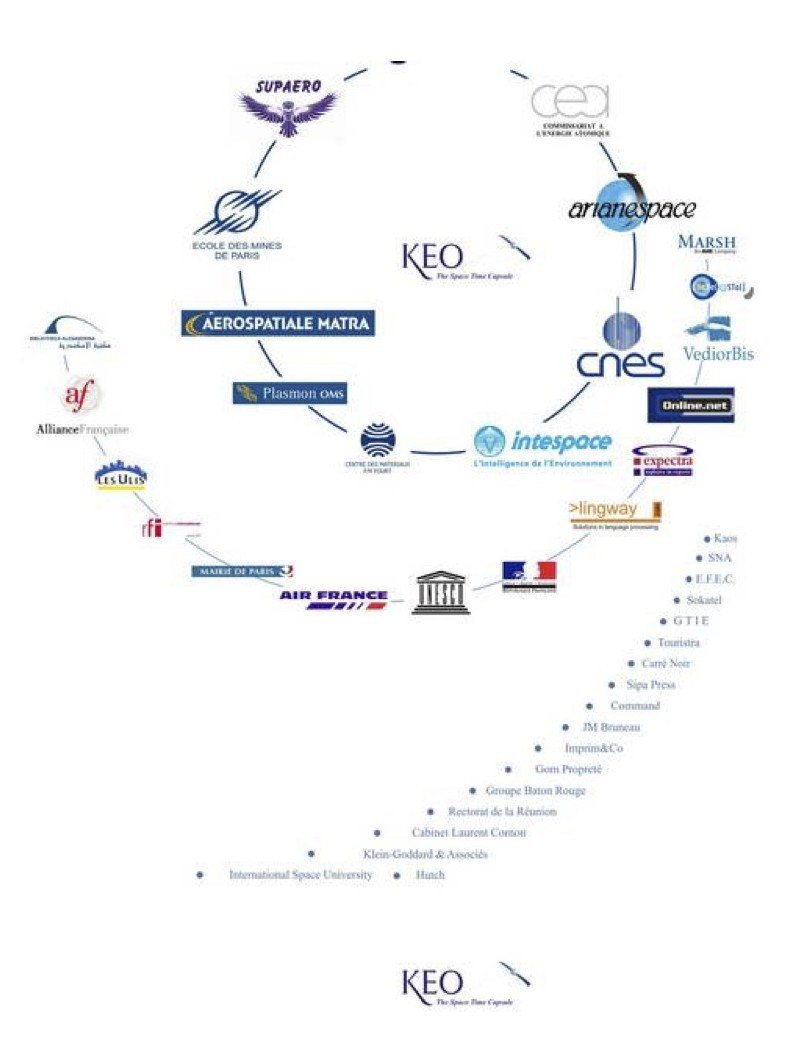
“Carried out free of any political, religious or commercial influence”, KEO brought together more than forty companies and institutions that lent their support free of charge.
- Construction and launch of the satellite: Aérospatiale Matra and later EADS, Arianespace and Starsem, the CEA, CNES, the École des mines de Paris, Intespace, Sup'Aéro, Plasmon (engraving of the glass discs).
- Institutions: UNESCO, the European Space Agency, the International Olympic Committee, the International Federation for Human Rights, the Ligue des droits de l'homme, the Alliance française, the Ministry of Foreign Affairs, the Musée du Louvre, the Musée de la civilisation in Quebec City.
- Communication and computing: BaBeL@StaL (the keo.org website, Ars Electronica prize 1999), Carré Noir, Kaos, Mikros Image, RFI, Cable & Wireless, Lingway, among others.
At the exhibitions, technology showcases presented the materials of the satellite, lent by the partner laboratories.
After 2008
Jean-Marc Philippe died on 12 November 2008. On 21 January 2009, Federico Mayor called for his dream to be brought to fruition: “In this sense KEO is the very model of a successful cross-fertilisation between tangible and intangible heritage, between the sciences and the Arts, between the future and the past.” Patrick Tejedor, president of the KEO Programme association, then sought new partners; on 22 November 2012, at the Maison de l'UNESCO, the International Fund for the Promotion of Culture announced that it was taking up the torch. The satellite has not been launched. The team continued the collection until 2025, the year in which it came to an end and the keo.org website closed.
References and links
Books, catalogues and journals
- Jacques Mousseau, “Kéo, l'oiseau communicant”, Communication & Langages, no. 122, 1999, pp. 4-10 (Persée).
Press
- Declan Butler, “Space 'time capsule' could send a message to the future”, Nature, no. 391, 8 January 1998 (online).
- Véronique Maurus, “Retour vers le futur”, Le Monde, 16 August 1998 (online).
- Jean-Marie Decorse, “Avec Keo, rendez-vous dans 50.000 ans”, La Dépêche du Midi, 15 May 1999 (online).
- “Keo en route pour le futur”, L'Humanité, 18 March 2000 (online).
- Pierre Barthélémy, “Le satellite KEO attend vos messages pour les Terriens du DXXIe siècle”, Le Monde, 12 July 2002 (online).
- John Lichfield, “Time capsule to orbit planet earth for 50,000 years”, Irish Independent, 12 July 2002 (online).
- Karishma Upadhyay, “Around the universe in 50,000 years”, The Times of India, 17 September 2002 (online).
- Marie-Julie Gagnon, “Retour vers le futur”, La Presse (Montreal), 20 February 2004.
- Elisabeth Chardon, “La Bâtie sert de relais à KEO, une œuvre planétaire qui attend encore la participation des Suisses”, Le Temps, 4 September 2004 (online).
- “Iran: KEO Initiator Expected”, Iran Daily, 16 February 2005 (online).
- “Near-Art Object”, Wired, 1st May 2006 (online).
- “Capsules temporelles, bouteilles à la mer et messages au cosmos”, Le Figaro, 10 October 2006 (online).
- Marc Vandermeir, “KEO, le satellite de vos espoirs”, La Libre Belgique, 6 April 2007 (online).
- “México en cápsula del tiempo que atestiguará el hoy”, Cuarto Poder (Chiapas) (online).
- Millie Servant, “10 ambitieuses capsules temporelles destinées aux générations futures”, Usbek & Rica, 17 June 2023 (online).
- Santiago Vargas, “Satélite KEO: el proyecto para enviarle un mensaje a la humanidad del año 52.000”, El Tiempo, 22 January 2024 (online).
- Claire L. Evans, “If We Want Anyone to Remember Humanity, We Need to Talk About Time Capsules”, Vice (online).
Online resources
- Prix Ars Electronica 1999, Ars Electronica archives.
- “KEO (satellite)” article, Wikipedia (French).